Sunday, July 24, 2016

Rare Views: Historic Cities from Around the World

Featuring Rare and Beautiful Views from Around the World!
Below are featured artists who are widely known for their grand display of important landmarks, landscapes and city-scapes 

David Roberts (1796-1864)
from The Holy Land, Syria, Idumea, Arabia, Egypt, and Nubia
London: 1842-1849
Hand-colored lithographs
Roberts began his grand tour of the Near East, departing for Alexandria in the summer of 1839, and spent the remainder of the year exploring Lower Egypt, encountering innumerable ancient ruins and monuments. Early in 1840, he embarked on a circuitous route to the Holy Land, via Mount Sinai and the legendary Nabataean city of Petra, in modern Jordan. He finally reached Jerusalem, before visiting other important sights in modern Israel, and finally concluding his tour in Syria. Upon his return to England, F.G. Moon introduced Roberts to the master lithographer Haghe, a collaboration that resulted in this masterpiece, which Abbey described as "one of the most Important and Elaborate
ventures of nineteenth-century publishing.
Rudolph Ackermann
The Repository of Arts, Literature, Commerce, Manufactures, Fashions and Politics
London: 1809-1828
Hand-colored engraving
Ackermann was a successful shop owner, his store the Repository of Arts opened in 1797 and became a spot for the English elite to socialize and shop for prints, illustrated books, decorative objects, art supplies, old master paintings and miniatures Ackermann extended his shop and created a yearly publication that showcased British manufacturing, in 1809 he began publishing his serious The Repository of Arts, Literature, Commerce, Manufacturers, Fashions ad Politics.  Ackermann's Repository, as it was also known, influenced English fashion, tastes, architecture, politics and literature throughout the Regency period and into the Georgian Era.

Carel Allard
“Constantinopel”
From Orbis habitabilis oppida et vestitus
c. 1695
Copperplate engraving
Allard is considered to be the first compiler of a townbook to couple the plates this way. Orbis habitabilis comprises 28 views of European towns , 24 Asian towns, 24 African towns and 24 American towns. The text for the book was in Latin by Ludolph Smids, a Groningen doctor and antiquary who settled in Amsterdam in 1685. The plates are by Aldert Meyer and Thomas Doesbergh, and Allard himself closely supervised the engraving of the plates.
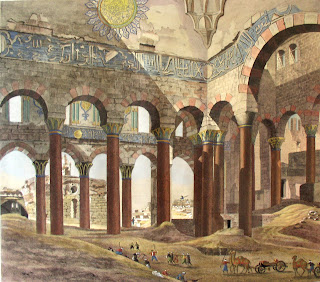
Henry Salt (1780-1827)
Twenty-four views in St. Helena, the Cape, India, Ceylon, the Red Sea, Abyssinia, and Egypt
London: William Miller, 1809
Hand-colored aquatint engravings 
In 1816 Salt was given the post of British Consul-General of Egypt. His position gave him unique opportunities to pursue his growing interest in the monuments and antiquities of Egypt. He employed archeologists such as Giovanni Belzoni to excavate ancient Egyptian sites, such as Thebes, Giza and Abu Simbel, and undertook important archeological research at the Pyramids of Giza and the Sphinx. Salt also collected a large number of artifacts, such as the head of Ramses II, most of the antiquities Salt collected were purchased by, and can be seen at, The British Museum and the Louvre.

Mathias Merian
From: Topographia Galliae
Amsterdam: 1661
Copperplate engravings
Mathias Merian was one of the most prominent members of the leading print publishing family of 17th-century Germany, known throughout Europe for his engravings of cityscapes and landscapes, his scientific books, and his editions of the noted series of travel books, the “Great Voyages.” Born and trained in Basel, Switzerland, Merian joined the Frankfurt publishing house of Johann Theodor de Bry in 1616 and, the following year, he married de Bry’s daughter Maria Magdalena. Merian gained his greatest acclaim as head of the family publishing house following the death of his father-in-law in 1623.
Here at Arader San Francisco we have a wonderful space that enables us to showcase our finest examples of rare maps and original works on paper, however we simply cannot showcase all the works we possess. For this reason we will be exclusively showcasing works from within our vast antiques inventory. Please follow our blog or join our mailing list by emailing us at Aradersf@sbcglobal.net.
For more information and pricing inquiries Please call 415-788-5115, or visit us at Arader Galleries 432 Jackson Street, San Francisco, Ca 94111.

Monday, July 18, 2016

Tropical Beaches: Island watercolors of the 19th Century

William Alister MacDonald (1860-1956)
Opunoho Bay Moorea
1928
Watercolor 
Summer is a time for much needed relaxation and fun in the sun, however here in San Francisco provides us with prolonged gloom, chilly weather and sometimes rain until the fall.

We mean to fill this summer weather void inside the gallery by showcasing the beautiful original watercolor Islandscapes painted by William Alister MacDonald (1860-1950), and Robert Taylor Pritchett (1828-1907).Within these Islandscapes Pritchett and MacDonalad depicted colorful atmosphere which the viewer is instantly transported to a tranquil and tropica lbeach scene. Large palm trees move with the breeze as the waters gently ripple from ocean waves.

William Alister MacDonald was the son of a Scottish Free Church Minister. In the 1880's MacDonald moved to London and began painting watercolor scenes of London, and in particular, the Thames. Towards the end of the 19th century, MacDonald was exhibiting his watercolors at the Academy and the Royal Society of British Artists. Robert Taylor Pritchett was a landscape and marine painter, contributed illustrations to many publication in the mid- to late-19th century, including the records of Darwin's voyage in the Journal of Researches into the Natural History & Geology of the Countries Visited During the Voyage Round the World.


William Alister MacDonald (1860-1956)
Dawn Full moon
1928
Watercolor 

Robert Taylor Pritchett (1828-1907)
Tahiti
1921
Watercolor 
For more information and pricing inquiries Please call 415-788-5115, or visit us at Arader Galleries 432 Jackson Street, San Francisco, Ca 94111.

Tuesday, July 12, 2016

Thomas Moore: Ferns of Great Britain and Ireland

On View: The Fine works of Thomas Moore
Thomas Moore (1821-1887)
Ferns of Great Britain and Ireland
London: 1855
Pressed Nature Prints
Moore was an English botanist and gardener who most notably helped with the botanical design of Regent's Park gardens, and became editor of several gardening publications; Such as: the Gardeners' Magazine of Botany, the Garden Companion and Florists' Guide, the Floral Magazine, among others. He also acted as the secretary to the floral committee and floral director of the Royal Horticultural Society.  Moore's passion was focused on the study of ferns, which lead to his extensive regional publication, Ferns of Great Britain and Ireland.

From the early fifteenth century on wards experiments with making prints from pressed leaves and flowers were conducted. The first ventures into this technique were relatively simple with the specimen inked and paper laid upon it. Pressure was then applied by hand to gain an impression. This rather crude method was advanced and perfected during the nineteenth century by the Imperial Printing Office in Vienna. Plants were now passed under pressure between a lead and a steel plate and an electrotype made, on the lead plate, from the impression. It was this innovative technique that Thomas Moore chose for the creation of the plates in his splendid book, Ferns of Great Britain and Ireland. The plates were produced for Moore by Henry Bradbury and are the finest example of nature-printing available. Indeed, Thomas Moore’s book heralded a craze for ferns during the nineteenth century perhaps because of the exquisite delicacy of the images projected.
For more information and pricing inquiries Please call 415-788-5115, or visit us at Arader Galleries 432 Jackson Street, San Francisco, Ca 94111.


Saturday, July 2, 2016

Warren Heckrotte Summer Catalog

Adrien Hubert Brue (1786-1832)
Nouvelle Carte du Mexique, Et D'une Partie de Provineces Unies De L'Amerique Centrale
Paris: 1834
Hand-colored copper-plate engraving
2 Sheets: 36 4/8” x 24 4/8”, Framed: 32 3/4” x 45”

We are happy to announce that a Special limited West Coast Maps Catalog will be distributed this Summer season. Please request a copy of this catalog by contacting the gallery.

You can also view the entire collection online here, view our Exhibition onsite during our open hours, or you can make a special appointment with a call to the gallery.

We are delighted to share this collection with you, including a total of 14 rare maps exquisitely preserved of Gold Rush California, Oregon, Texas, and Mexico. This collection was formerly owned by the Bay Area maps Collector Warren Heckrotte.

For more information or to make an appointment Please call 415-788-5115, Arader Galleries 432 Jackson Street, San Francisco, Ca 94111.

Sunday, June 19, 2016

Warren Heckrotte's Collection of Rare West Coast Maps

James Imray (1803-1870) 
West Cost of North America from San Blas to San Francisco
London: 1883

Featuring a new special exhibition to the Gallery parts of the collection of Warren Heckrotte. Visit the Gallery to view 14 of Heckrotte's coveted rare maps of the West Cost. This collection features exquisite maps of Gold Rush Era Oregon, California, Texas and Mexico.

San Francisco local Warren Heckrotte was a rare books and maps buyer who began building his collection in the 1960’s, “making his first purchase, of three “decorative” maps, in Geneva, Switzerland, in 1963” while working in Geneva as a physicist at the Lawrence Livermore Labratory where he served as representative of the Atomic Energy Commission. This first maps purchase sparked Mr. Heckrotte’s passion for maps and his desire to continue to grow his academic knowledge of antique maps. He began, as many map collectors do, with a study of R.V. Tooley’s Maps and Map-Makers. As his collection grew so did his knowledge and self academic understanding of maps, He edited and contributed to California 49: Forty-nine Maps of California from the 16th Century to the Present, published in San Francisco in 1999.
 B.F. Butler 
Map of the Gold Region California
San Francisco: 1851
A.D Bache (1806-1867)
Entrance to San Francisco Bay California
From: A trigonometrical Survey
Washington: U.S. Coastal Survey: 1859


For more information or to make an appointment Please call 415-788-5115, Arader Galleries 432 Jackson Street, San Francisco, Ca 94111.

Sunday, June 12, 2016

Henstenburgh a Still Life Master


Circle of Herman Henstenburgh (1667-1726)
A Still Life with Fruits and Nuts on a Stone
Watercolor and pencil on vellum
Signed on Ledge: Henstenburgh fecit, 1761

Herman Henstenburgh was a pupil of Johannes Bronckhorst, a fellow native of Hoorn in the Netherlands and according to contemporary accounts, his early works very much imitated those of his master, depicting birds and landscapes. Henstenburgh was a pupil of Johannes Bronckhorst, a fellow native of Hoorn in the Netherlands and according to contemporary accounts, his early works very much imitated those of his master, depicting birds and landscapes. He later broadened his repertoire to include splendid flower and fruit pieces, and occasional woodland still-lifes, such as this one. For his flawless draftsmanship and vibrant colors, Henstenburgh won considerable renown even during his own lifetime.

Monday, June 6, 2016

Summer Auction Picks of the Week

With our Summer auction only 6 days away, we would like to present one last highlight from this month's auction selection.

Please Contact the gallery if you have questions about the bidding process, or need further information about a particular lot. Our gallery associates are quick to respond to your needs and will help ensure a successful auction outcome. We are driven to perfect and grow your collection, and provide you with the tools necessary to do so.

Highlight of the Week: Lot 12
Chuck-Will's Widow, Plate 52
37 x 49" framed
Once Audubon had committed to his project, producing the monumental Birds of America, it fell to him to find an engraver and subscribers. After a failed attempt to drum up interest in Philadelphia, he turned to Europe. Departing from New Orleans in 1826, he arrived in Liverpool first. While in Europe, he presented himself as a romanticized American woodsman. He dressed in buckskins and applied bear grease to his long hair, playing to the English’s attraction to characters of frontier culture. He brought more than 300 pictures, which were exhibited in Liverpool, Manchester, and Edinburgh where they were enthusiastically well-received by a scientific community much preoccupied with little-known lands. While in Edinburgh, Audubon was directed to William Home Lizars (1788 – 1859), the finest engraver in the city. Lizars was so impressed by Audubon’s drawings that he put aside a project and agreed to instead take on the formidable task of engraving the plates for Audubon’s “Great Work.” Work on the first part began in November 1826 and by January 1827 the first five images were printed. Audubon’s relationship with Lizars was, however, not long-lasting. During the production of the first two parts Lizars’ colorists went on strike, and in June 1827 Audubon retrieved the ten completed plates and began his search for a new engraver.
In London, he met Robert Havell, Sr. (1774 – 1832), a print maker. Havell, Sr., felt he was too old for such an undertaking, but his son Robert Jr. (1793 – 1878) entered into a partnership with him and together they brought to fruition Audubon’s massive work, The Birds of America.
Audubon’s prints are, in a word, stunning. He was an exceptional naturalist. The striking posture of the birds displays as much of their shape and plumage as possible, with a degree of detail that proves the extent of his research. Audubon stood out from other ornithological naturalists of his time by depicting his birds in dynamic, active attitudes, rather than just in profile. The artist’s eye and hand can be seen on every page; the birds have personalities, and with them, Audubon cemented his status as an American archetype, as much a part of our national folklore as George Washington or Johnny Appleseed.