Showing posts with label France. Show all posts

Sunday, July 24, 2016

Rare Views: Historic Cities from Around the World

Featuring Rare and Beautiful Views from Around the World!
Below are featured artists who are widely known for their grand display of important landmarks, landscapes and city-scapes 

David Roberts (1796-1864)
from The Holy Land, Syria, Idumea, Arabia, Egypt, and Nubia
London: 1842-1849
Hand-colored lithographs
Roberts began his grand tour of the Near East, departing for Alexandria in the summer of 1839, and spent the remainder of the year exploring Lower Egypt, encountering innumerable ancient ruins and monuments. Early in 1840, he embarked on a circuitous route to the Holy Land, via Mount Sinai and the legendary Nabataean city of Petra, in modern Jordan. He finally reached Jerusalem, before visiting other important sights in modern Israel, and finally concluding his tour in Syria. Upon his return to England, F.G. Moon introduced Roberts to the master lithographer Haghe, a collaboration that resulted in this masterpiece, which Abbey described as "one of the most Important and Elaborate
ventures of nineteenth-century publishing.
Rudolph Ackermann
The Repository of Arts, Literature, Commerce, Manufactures, Fashions and Politics
London: 1809-1828
Hand-colored engraving
Ackermann was a successful shop owner, his store the Repository of Arts opened in 1797 and became a spot for the English elite to socialize and shop for prints, illustrated books, decorative objects, art supplies, old master paintings and miniatures Ackermann extended his shop and created a yearly publication that showcased British manufacturing, in 1809 he began publishing his serious The Repository of Arts, Literature, Commerce, Manufacturers, Fashions ad Politics.  Ackermann's Repository, as it was also known, influenced English fashion, tastes, architecture, politics and literature throughout the Regency period and into the Georgian Era.

Carel Allard
“Constantinopel”
From Orbis habitabilis oppida et vestitus
c. 1695
Copperplate engraving
Allard is considered to be the first compiler of a townbook to couple the plates this way. Orbis habitabilis comprises 28 views of European towns , 24 Asian towns, 24 African towns and 24 American towns. The text for the book was in Latin by Ludolph Smids, a Groningen doctor and antiquary who settled in Amsterdam in 1685. The plates are by Aldert Meyer and Thomas Doesbergh, and Allard himself closely supervised the engraving of the plates.
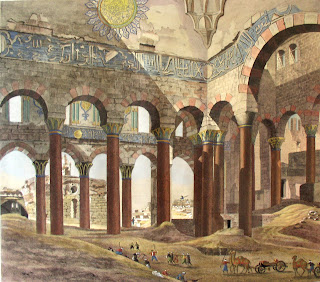
Henry Salt (1780-1827)
Twenty-four views in St. Helena, the Cape, India, Ceylon, the Red Sea, Abyssinia, and Egypt
London: William Miller, 1809
Hand-colored aquatint engravings 
In 1816 Salt was given the post of British Consul-General of Egypt. His position gave him unique opportunities to pursue his growing interest in the monuments and antiquities of Egypt. He employed archeologists such as Giovanni Belzoni to excavate ancient Egyptian sites, such as Thebes, Giza and Abu Simbel, and undertook important archeological research at the Pyramids of Giza and the Sphinx. Salt also collected a large number of artifacts, such as the head of Ramses II, most of the antiquities Salt collected were purchased by, and can be seen at, The British Museum and the Louvre.

Mathias Merian
From: Topographia Galliae
Amsterdam: 1661
Copperplate engravings
Mathias Merian was one of the most prominent members of the leading print publishing family of 17th-century Germany, known throughout Europe for his engravings of cityscapes and landscapes, his scientific books, and his editions of the noted series of travel books, the “Great Voyages.” Born and trained in Basel, Switzerland, Merian joined the Frankfurt publishing house of Johann Theodor de Bry in 1616 and, the following year, he married de Bry’s daughter Maria Magdalena. Merian gained his greatest acclaim as head of the family publishing house following the death of his father-in-law in 1623.
Here at Arader San Francisco we have a wonderful space that enables us to showcase our finest examples of rare maps and original works on paper, however we simply cannot showcase all the works we possess. For this reason we will be exclusively showcasing works from within our vast antiques inventory. Please follow our blog or join our mailing list by emailing us at Aradersf@sbcglobal.net.
For more information and pricing inquiries Please call 415-788-5115, or visit us at Arader Galleries 432 Jackson Street, San Francisco, Ca 94111.

Sunday, April 17, 2016

Zoological Illustrations by Cuvier and Saint-Hilaire

Cuvier and Saint-Hilaire
 Mandrill Male
Lithograph
20"x13"
The works from Histoire Naturelle Des Mammiferes, Avec Les figures Originales.d'aprs Des Animaux Vivians, 1824-42 was crafted by a friendship that introduced the French zoological and natural history community with the finest illustrations of exotic mammals. These lithographs captured the movement and personality of the animal while depicting scientifically accurate compositions. Similar innovation as to the design and depiction of mammals could be compared to the works of acclaimed American ornithologist John James Audubon (1785-1851).

Frederic Cuvier (1769-1832) was a French zoologist and paleontologist who worked for the Museum d'histoire Naturelles in Paris, while  Geoffroy Saint-Hilaire (1772-1844) was a French naturalist and evolutionary theorist. The two met in 1794 and formed a close friendship shortly after. This friendship lead to the creation of a great feet, the production of Five memoirs on natural history, one of which was a study on the classification of mammals. 
Cuvier and Saint-Hilaire
Renard Argente
Lithograph
18"x12"
The original publication of  Histoire Naturelle Des Mammiferes, Avec Les figures Originales.d'aprs Des Animaux Vivians was intended to have 72 parts to be bound in 7 volumes. This publication was made in conjunction with the Museum d'Histoire Naturelles in Paris. Most of the animals were drawn from life at the Paris Zoo Jardin de Plantes. Cuvier provided descriptions for each mammal while Hilaire edited the work and  provided additional articles.  
Cuvier and Saint-Hilaire
Kiodote
Lithograph
20"x13"
For purchase inquiries please call 415-788-5115, or feel free to stop by Arader Galleries, at 435 Jackson Street, San Francisco. 

Wednesday, December 5, 2012

Maathaus Merian's Copperplate Engravings

          Matthaus Merian was born in Basel around 1593. As a young boy he was taught the craft of glass-painting but soon switched over to copper-plate engraving. This is the trade that he is known for today. During the years of his apprenticeship he moved to Zurich and traveled through many places in Germany, Switzerland, and France.
          In 1616, Merian began working at a publishing house in Frankfurt under Johann Theodor de Bry. One year later, Merian married de Bry's daughter and had 3 children. Both sons went into the publishing business and his daughter became an acclaimed naturalist and illustrator. Following the death of Johann, Merian was given control over the publishing company and thus became a citizen of Frankfurt.This is where he spent most of his time.
Although he spent most of his life as a Publisher, Merian is best know for his copperplate engravings.To make a copperplate engraving, Merian would start with a sheet of copper and coat it with a waxy substance. He then used a hardened steel point to cut a design into the waxy surface and onto the copper. All metal shavings and wax were removed and the plate was heated. Ink as poured over the hot copper sheet until all of the ridges were filled with ink. Now the plate could be wiped clean and placed in a printing press to be printed onto a damp piece of parchment. Copperplate engraving was a very time-consuming and meticulous practice.
Topographia Germaniae is a 21 volume produced and published by Merian. These volumes included views of towns and cities along with maps of major cities of the world. Collectively, the volumes include over 2,000 copperplate engravings completed by himself. The dedication he had to his craft helped him slowly become the most recognized copper plate engravers in Europe at the time and today.

Tuesday, May 13, 2008

Celebrating the Art of France with the French Heritage Society


Arader Galleries hosted a reception on May 1, 2008 for the French Heritage Society to celebrate The Art of France, a collection of extraordinary 16th through 19th century works of art. The French Heritage Society is dedicated to preserving French architectural, cultural and historical patrimony in the United States and France, and to furthering American-French understanding through student and professional exchanges in the field of preservation.

The event helped to raise funds for the French Heritage Society's current efforts to restore the early 17th Century Chateau de Reveillon. It was a lovely evening, and we thank the all of the attendees for their interest in learning about our collection of French artists.


Saturday, November 3, 2007

Upcoming Exhibition: Marie-Antoinette and the Petit Trianon at Versailles

Marie-Antoinette and the Petit Trianon at Versailles
November 17, 2007 — February 17, 2008
Legion of Honor, San Francisco

Marie-Antoinette, the Austrian-born queen of Louis XVI of France, was given the Petit Trianon, a small château secluded in the park at Versailles, upon her accession in 1774. An icon of French neoclassicism, it exemplifies the perfection of 18th-century French architecture through its delicate balance of form and proportion. Its interiors were furnished to the queen's order with pieces of the utmost elegance, restraint, and beauty. This exhibition gives a visual history of the Petit Trianon through 88 pieces of the finest furniture, paintings, and sculpture from this château. It is complemented by watercolors, prints, and drawings of the house and its innovative landscaping, including the picturesque Hameau, a rustic village where the queen and her favorites could relax away from the prying eyes of the court at Versailles. This is the only venue of the exhibition, which is organized by the Musée National of the Château de Versailles. Link


A Grand View of the Gardens of Versailles

Pierre le Pautre
“Plan General de la Ville & du Chateau de Versailles, des Jardins, Bosquets et Fountaines”
Paris: 1717
Hand-colored copperplate engraving
Paper size: 37 ½" x 50"
Framed size: 43 ½" x 56 ½"

Louis XIV (1638-1715), the Sun King of France, had grown up during a civil war between rival factions of aristocrats, known as the Fronde, and wanted a site where he could control the French government by absolute rule. Louis settled on the royal hunting lodge at Versailles, which had been acquired by Louis XIII in 1632, and over the following decades expanded it into the largest palace and grounds in the world. It was Louis XIV's hope to create a center for the royal court at Versailles.

Beginning in 1669, the architect, Louis Le Vau (1612-1670), began a detailed renovation of the château. The Château of Versailles, outside of Paris, was converted into a spectacular royal palace in a series of four major and distinct building campaigns. By the end of the third building campaign, the Château had taken on most of the appearance that it retains to this day, except for the Royal Chapel in the last decade of the reign. Louis XIV officially moved to Versailles, along with the royal court, on May 6, 1682.

Louis had several reasons for creating such a symbol of extravagant opulence and stately grandeur, and for shifting the seat of the monarch. By moving the royal court and the seat of the French government, Louis XIV hoped to gain greater control of the government from the nobility. All the power of France emanated from this centre: there were government offices here, as well as the homes of thousands of courtiers and all the attendant functionaries of court. By requiring that nobles of a certain rank and position spend time each year at Versailles, Louis prevented them from developing their own regional power and kept them from countering his efforts to centralize the French government in an absolute monarchy. Thus, many noblemen had to either to give up all influence, or to depend entirely on the king for grants and subsidies. Instead of exercising power and potentially creating trouble, the nobles vied for the honor of dining at the king’s table or the privilege of carrying a candlestick as the king retired to his bedroom.

Versailles also served as a dazzling and awe-inspiring setting for state affairs and for the reception of foreign dignitaries, where the attention was not shared with the city of Paris, but was assumed solely by the king. Court life centered on magnificence; courtiers lived lives of expensive luxury, dressed with suitable magnificence and constantly attended balls, dinners, performances and celebrations.

This grand view showcases the garden plan of Versailles, the grounds of which are the largest formal gardens ever created, with extensive fountains and canals (identified with a key on either side of the illustrated garden plan). The gardens at Versailles were designed by the landscape architect André Le Nôtre (1673-1700). Le Nôtre modified the original gardens by expanding them and giving them a sense of openness and larger scale. The plan was centered by the central axis of the Grand Canal (le Canal), an ornamental body of water covering 105 acres. The gardens are centered on the south front of the palace, which is set on a terrace, giving the palace a sweeping view of the gardens. The Fountain of Latona (6) is located at the foot of the steps, and tells a story taken from Ovid’s poem Metamorphoses, which was considered an allegory of the Fronde, the French civil war (1646-53) that occurred when Louis XIV was a child. Beyond this is the Fountain of Apollo (15 - Bassin d’Apollon), which symbolizes the regime of the Sun King. To the right of the Grand Canal is Trianon, a getaway built by Louis XIV to spend time with his family, and unwind from the tedium of life at the royal court. Far into the distance lie the dense woods of the King’s hunting grounds.

This view is currently on view at Arader Galleries and is available for purchase.