Showing posts with label england. Show all posts

Sunday, July 24, 2016

Rare Views: Historic Cities from Around the World

Featuring Rare and Beautiful Views from Around the World!
Below are featured artists who are widely known for their grand display of important landmarks, landscapes and city-scapes 

David Roberts (1796-1864)
from The Holy Land, Syria, Idumea, Arabia, Egypt, and Nubia
London: 1842-1849
Hand-colored lithographs
Roberts began his grand tour of the Near East, departing for Alexandria in the summer of 1839, and spent the remainder of the year exploring Lower Egypt, encountering innumerable ancient ruins and monuments. Early in 1840, he embarked on a circuitous route to the Holy Land, via Mount Sinai and the legendary Nabataean city of Petra, in modern Jordan. He finally reached Jerusalem, before visiting other important sights in modern Israel, and finally concluding his tour in Syria. Upon his return to England, F.G. Moon introduced Roberts to the master lithographer Haghe, a collaboration that resulted in this masterpiece, which Abbey described as "one of the most Important and Elaborate
ventures of nineteenth-century publishing.
Rudolph Ackermann
The Repository of Arts, Literature, Commerce, Manufactures, Fashions and Politics
London: 1809-1828
Hand-colored engraving
Ackermann was a successful shop owner, his store the Repository of Arts opened in 1797 and became a spot for the English elite to socialize and shop for prints, illustrated books, decorative objects, art supplies, old master paintings and miniatures Ackermann extended his shop and created a yearly publication that showcased British manufacturing, in 1809 he began publishing his serious The Repository of Arts, Literature, Commerce, Manufacturers, Fashions ad Politics.  Ackermann's Repository, as it was also known, influenced English fashion, tastes, architecture, politics and literature throughout the Regency period and into the Georgian Era.

Carel Allard
“Constantinopel”
From Orbis habitabilis oppida et vestitus
c. 1695
Copperplate engraving
Allard is considered to be the first compiler of a townbook to couple the plates this way. Orbis habitabilis comprises 28 views of European towns , 24 Asian towns, 24 African towns and 24 American towns. The text for the book was in Latin by Ludolph Smids, a Groningen doctor and antiquary who settled in Amsterdam in 1685. The plates are by Aldert Meyer and Thomas Doesbergh, and Allard himself closely supervised the engraving of the plates.
Henry Salt (1780-1827)
Twenty-four views in St. Helena, the Cape, India, Ceylon, the Red Sea, Abyssinia, and Egypt
London: William Miller, 1809
Hand-colored aquatint engravings 
In 1816 Salt was given the post of British Consul-General of Egypt. His position gave him unique opportunities to pursue his growing interest in the monuments and antiquities of Egypt. He employed archeologists such as Giovanni Belzoni to excavate ancient Egyptian sites, such as Thebes, Giza and Abu Simbel, and undertook important archeological research at the Pyramids of Giza and the Sphinx. Salt also collected a large number of artifacts, such as the head of Ramses II, most of the antiquities Salt collected were purchased by, and can be seen at, The British Museum and the Louvre.

Mathias Merian
From: Topographia Galliae
Amsterdam: 1661
Copperplate engravings
Mathias Merian was one of the most prominent members of the leading print publishing family of 17th-century Germany, known throughout Europe for his engravings of cityscapes and landscapes, his scientific books, and his editions of the noted series of travel books, the “Great Voyages.” Born and trained in Basel, Switzerland, Merian joined the Frankfurt publishing house of Johann Theodor de Bry in 1616 and, the following year, he married de Bry’s daughter Maria Magdalena. Merian gained his greatest acclaim as head of the family publishing house following the death of his father-in-law in 1623.
Here at Arader San Francisco we have a wonderful space that enables us to showcase our finest examples of rare maps and original works on paper, however we simply cannot showcase all the works we possess. For this reason we will be exclusively showcasing works from within our vast antiques inventory. Please follow our blog or join our mailing list by emailing us at Aradersf@sbcglobal.net.
For more information and pricing inquiries Please call 415-788-5115, or visit us at Arader Galleries 432 Jackson Street, San Francisco, Ca 94111.

Tuesday, July 12, 2016

Thomas Moore: Ferns of Great Britain and Ireland

On View: The Fine works of Thomas Moore
Thomas Moore (1821-1887)
Ferns of Great Britain and Ireland
London: 1855
Pressed Nature Prints
Moore was an English botanist and gardener who most notably helped with the botanical design of Regent's Park gardens, and became editor of several gardening publications; Such as: the Gardeners' Magazine of Botany, the Garden Companion and Florists' Guide, the Floral Magazine, among others. He also acted as the secretary to the floral committee and floral director of the Royal Horticultural Society.  Moore's passion was focused on the study of ferns, which lead to his extensive regional publication, Ferns of Great Britain and Ireland.

From the early fifteenth century on wards experiments with making prints from pressed leaves and flowers were conducted. The first ventures into this technique were relatively simple with the specimen inked and paper laid upon it. Pressure was then applied by hand to gain an impression. This rather crude method was advanced and perfected during the nineteenth century by the Imperial Printing Office in Vienna. Plants were now passed under pressure between a lead and a steel plate and an electrotype made, on the lead plate, from the impression. It was this innovative technique that Thomas Moore chose for the creation of the plates in his splendid book, Ferns of Great Britain and Ireland. The plates were produced for Moore by Henry Bradbury and are the finest example of nature-printing available. Indeed, Thomas Moore’s book heralded a craze for ferns during the nineteenth century perhaps because of the exquisite delicacy of the images projected.
For more information and pricing inquiries Please call 415-788-5115, or visit us at Arader Galleries 432 Jackson Street, San Francisco, Ca 94111.


Sunday, May 29, 2016

Feature from June 11th Action: Lot 110

With our June 11th action only 2 weeks away we would like to showcase another preview of a selected work from the auction, bringing to light its context and historical significance. 

The auction will begin at 1pm EST at our Madison Avenue Gallery in New York City. As always we are happy to provide offsite bidding options if you cannot be present.

To preview lots online: https://www.liveauctioneers.com/arader-galleries

Auction Highlight: Jane Austin's Bath


Lot 110 John Claude Nattes  (C. 1765-1822)
Bath, Illustrated by a Series of Views  
London: William Miller; Bristol: William Sheppard, 1806.
Estimate: $15,000 - 20,000.  Retail Price: $35,000
The beautiful plates include iconic views of Bath from the Claverton Road, the Royal Crescent, the Pump Room, and Concert-Room dating from the time when Jane Austen was living there with her family (1802-1806). Jean-Claude Nattes was one of the most successful watercolour artists of his time. He exhibited at the Royal Academy between 1782 and 1814, and at the Old Watercolour Society, of which he was a founding member. However, in 1807, shortly after publication of this magnificent series of views of Bath, and at the height of his success, Nattes was excluded from the Society after accusations of exhibiting work of other artists under his own name. Abbey Scenery 41; Tooley 340.

To be placed on our auction mailing list or to review a copy of the catalog in the mail please call us (415) 788-5115, or if you have any questions.

Monday, April 11, 2016

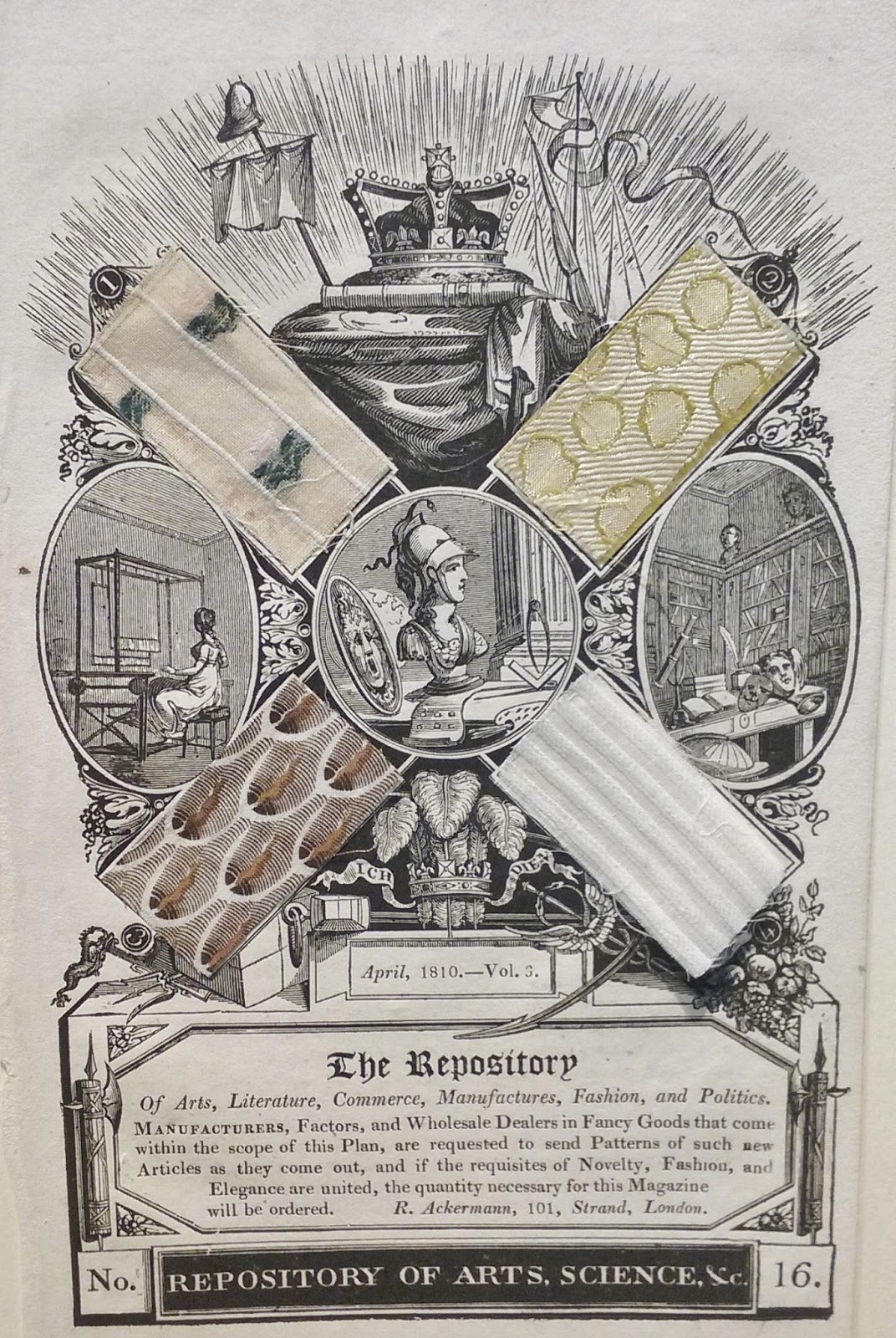
Ackermann's Repository: Allegorical Textile Woodcuts from Regency England


R. Ackermann
No.16
 c.1810-1813
Woodcut engraving with Fabric Samples
One of the many people who took advantage of England's industrial age was a printmaking entrepreneur named Rudolph Ackermann (1764-1834), an Anglo-German bookseller, inventory, lithographer and publisher. Among other things he was also a successful shop owner, his store the Repository of Arts opened in 1797 and became a spot for the English elite to socialize and shop for prints, illustrated books, decorative objects, art supplies, old master paintings and miniatures.

Ackermann extended his shop and created a yearly publication that showcased British manufacturing, in 1809 he began publishing his serious The Repository of Arts, Literature, Commerce, Manufacturers, Fashions ad PoliticsAckermann's Repository, as it was also known, influenced English fashion, tastes, architecture, politics and literature throughout the Regency period and into the Georgian Era.
 R. Ackermann
No. 17
 c.1810-1813
Woodcut engraving with Fabric Samples
In an effort to boost British manufacturing and commerce, Ackermann included textile samples from premiere manufacturers. These woodcut engraving showcased real fabric samples that were adhered to the engraving. These fabric swatches appealed to fashion lovers and those who furnishing and designing their homes. On the next page the fabric swatches are described and note its designed cultural influences. The pieces of fabric stand out again an allegorical background, featuring a woman at her loom, a bust of Athena and her shield of Medusa near the Freemason's symbol the compass and square. And to the far right  a library filled with busts, books, and other minute cultural references. Mast sails peak out of the background, floating around a German Imperial Crown. Below features the symbol of the prince of whales, an emblem of the British Monarchy, a crown with silver ostrich feathers. Perhaps these crowns are featured because of Ackermann's cultural heritage.

Interestingly The Repository's last issue in 1829 was a dedicated fashion issue. Though Ackermann's shop closed and his Repository issues ended, his print making legacy was carried on by his decedents till the late 20th century.

A selection of Ackermann's Repository Textile Woodcuts will be featured in our under $300 section at the Hillsborough Spring Antique Show April 29-May 1. These works will be accompanied by our magnificent Audubon quadrupeds, Redoute flowers, Double Hemisphere projections, and California maps.

Feel free to can contact the gallery at (415)-788-5115.
Aader Galleries 432 Jackson Street, San Francisco, Ca, 94111

Wednesday, August 5, 2009

A wonderful trip to Hidcote Manor Gardens in Gloucestershire


Hidcote Manor is a delightful surprise, hidden down a series of twisting country lanes in the Cotswolds. I had the opportunity to pay these incredible gardens a visit last month and spend time in the many ‘rooms’ of this fabulous estate run by The National Trust, Europe’s largest conservation organization.


The gardens at Hidcote Manor were designed and developed by Maj. Lawrence Johnston, a wealthy and well educated American, scion of a Baltimore stock broking family, who became a naturalized British subject and fought with the British Army in the Boer and First World Wars. Johnston was an avid plant collector and horticulturalist who sponsored and participated in plant hunting expeditions to secure rare and exotic species for this truly unbelievable garden.


Maj. Johnston's mother, Gertrude Winthrop, bought the Hidcote estate for her son in 1907. During the 1920s and 30s, Johnston worked with 12 full time gardeners to design and plant the garden. He was advised by many of the top artists and garden designers of the day including Alfred Parsons and Gertrude Jekyll. Johnston traveled the world in his search for unusual plants, participating in plant collecting expeditions to the Swiss Alps, the Andes, South Africa, Kenya, Burma, the South of France, Formosa, the Maritime Alps and the Atlas Mountains. Johnston is known to have introduced more than 40 new plants to the United Kingdom. Many of them now bear his name.


Hope you will enjoy these recent photos and plan a trip the next time you find yourself in London. It is just a 2 hours drive from the city center.