Showing posts with label views. Show all posts

Monday, May 22, 2017

Summer Auction Preview at Arader Galleries


Summer Auction PREVIEW

Cheers to another Auction! Set your Calendar to June 3rd for the opportunity to bid on a grand selection of original natural history works, spectacular views, and rare maps. The auction begins at 1pm EST. at our 1016 Madison Avenue Gallery.

This preview includes highlights from the auction, as great pieces to consider and add you your personal collection! Scroll to see detailed images and information. 


Lot 10 ● CAROLINA PARROT, PLATE 26
John James Audubon, Elephant Folio 1st Edition Havell

Lot 195 ● AMERICA NOVA TABULA
Willem Blaeu (1571-1638)

Lot 78 ● AN URN GARLANDED WITH FLOWERS, PEACHES, GRAPES, HAZELNUTS AND VARIOUS INSECTS ON A STONE LEDGE
Herman Henstenburgh (1667-1726)

Lot 29 ● RAMPHASTOS CUVIERI  (CUVIER’S TOUCAN)
John Gould (1804 - 1881)

Lot 91 ● THE VILLAGE PLOSSO IN THE PROVINCE OF MADIUN, JAVA
Jacob Dirk Van Herwerden (1806-1879)

Lot 155 ● MOSKOW, NO. 12
Cornelius Le Bruyn (1652-1726)

Online and phone bidding options are always available for inquiries and to access a copy of the auction catalog please call 415-788-5115. You can also bid at Liveauctioneers.com and view lots presented.
Arader Galleries, San Francisco 432 Jackson St, San Francisco, Ca 94111

Sunday, July 24, 2016

Rare Views: Historic Cities from Around the World

Featuring Rare and Beautiful Views from Around the World!
Below are featured artists who are widely known for their grand display of important landmarks, landscapes and city-scapes 

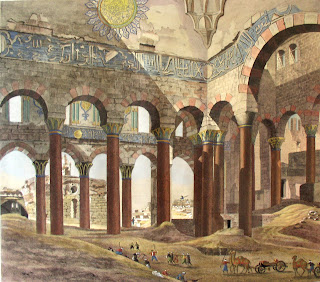
David Roberts (1796-1864)
from The Holy Land, Syria, Idumea, Arabia, Egypt, and Nubia
London: 1842-1849
Hand-colored lithographs
Roberts began his grand tour of the Near East, departing for Alexandria in the summer of 1839, and spent the remainder of the year exploring Lower Egypt, encountering innumerable ancient ruins and monuments. Early in 1840, he embarked on a circuitous route to the Holy Land, via Mount Sinai and the legendary Nabataean city of Petra, in modern Jordan. He finally reached Jerusalem, before visiting other important sights in modern Israel, and finally concluding his tour in Syria. Upon his return to England, F.G. Moon introduced Roberts to the master lithographer Haghe, a collaboration that resulted in this masterpiece, which Abbey described as "one of the most Important and Elaborate
ventures of nineteenth-century publishing.
Rudolph Ackermann
The Repository of Arts, Literature, Commerce, Manufactures, Fashions and Politics
London: 1809-1828
Hand-colored engraving
Ackermann was a successful shop owner, his store the Repository of Arts opened in 1797 and became a spot for the English elite to socialize and shop for prints, illustrated books, decorative objects, art supplies, old master paintings and miniatures Ackermann extended his shop and created a yearly publication that showcased British manufacturing, in 1809 he began publishing his serious The Repository of Arts, Literature, Commerce, Manufacturers, Fashions ad Politics.  Ackermann's Repository, as it was also known, influenced English fashion, tastes, architecture, politics and literature throughout the Regency period and into the Georgian Era.

Carel Allard
“Constantinopel”
From Orbis habitabilis oppida et vestitus
c. 1695
Copperplate engraving
Allard is considered to be the first compiler of a townbook to couple the plates this way. Orbis habitabilis comprises 28 views of European towns , 24 Asian towns, 24 African towns and 24 American towns. The text for the book was in Latin by Ludolph Smids, a Groningen doctor and antiquary who settled in Amsterdam in 1685. The plates are by Aldert Meyer and Thomas Doesbergh, and Allard himself closely supervised the engraving of the plates.

Henry Salt (1780-1827)
Twenty-four views in St. Helena, the Cape, India, Ceylon, the Red Sea, Abyssinia, and Egypt
London: William Miller, 1809
Hand-colored aquatint engravings 
In 1816 Salt was given the post of British Consul-General of Egypt. His position gave him unique opportunities to pursue his growing interest in the monuments and antiquities of Egypt. He employed archeologists such as Giovanni Belzoni to excavate ancient Egyptian sites, such as Thebes, Giza and Abu Simbel, and undertook important archeological research at the Pyramids of Giza and the Sphinx. Salt also collected a large number of artifacts, such as the head of Ramses II, most of the antiquities Salt collected were purchased by, and can be seen at, The British Museum and the Louvre.

Mathias Merian
From: Topographia Galliae
Amsterdam: 1661
Copperplate engravings
Mathias Merian was one of the most prominent members of the leading print publishing family of 17th-century Germany, known throughout Europe for his engravings of cityscapes and landscapes, his scientific books, and his editions of the noted series of travel books, the “Great Voyages.” Born and trained in Basel, Switzerland, Merian joined the Frankfurt publishing house of Johann Theodor de Bry in 1616 and, the following year, he married de Bry’s daughter Maria Magdalena. Merian gained his greatest acclaim as head of the family publishing house following the death of his father-in-law in 1623.
Here at Arader San Francisco we have a wonderful space that enables us to showcase our finest examples of rare maps and original works on paper, however we simply cannot showcase all the works we possess. For this reason we will be exclusively showcasing works from within our vast antiques inventory. Please follow our blog or join our mailing list by emailing us at Aradersf@sbcglobal.net.
For more information and pricing inquiries Please call 415-788-5115, or visit us at Arader Galleries 432 Jackson Street, San Francisco, Ca 94111.

Sunday, May 22, 2016

A Feature from June 11 Auction Lot 184

Albert Bierstadt
Storm in the Rocky Mountains, Mt. Rosalie
Chromolithograph
paper size: 31 1/2 x 18 inches
framed size 41 x 27 1/2 inches
London: Thomas McLean, 1869
  Bierstadt was among the most successful 19th-century artists who worked to capture America's hopes for future greatness in the untamed expanses of the West, creating images of grandeur which could not help but add to America's love of the mythic frontier and the spirit of adventure and discovery that it represented.  To achieve his glorious compositions, Bierstadt combined both imaginary and actual elements to create scenes that were based as much in reality as in the ideal.   In educating the American public about the West, Bierstadt depicted a landscape which could rival any in Europe in magnificence, while conveying a distinctly American pioneer spirit that embodied the compelling notion of Manifest Destiny.

Born in Germany in 1830, Bierstadt came to the U.S. in 1832.  He spent his childhood in New Bedford, Massachusetts.  At the age of 23 he returned to Germany to study at the Academy in Dusseldorf.  Afterward he painted with Worthington Whittredge in Rome, returning to the U.S. in 1857.  The next year Bierstadt headed west with Colonel Lander's surveying expedition to map an overland route from St. Louis to the Pacific.  Bierstadt left the party to sketch the Wind River and Shoshone country on his own.  In 1863 he made another western trip with Fitzhugh Ludlow, who recorded the journey in The Heart of the Continent (1870).  The success of the paintings inspired by that experience placed Bierstadt in competition with Frederic Church as America's most successful painter of masterpiece landscapes, and together the two became the first American artists to rival their European colleagues.

Storm in the Rocky Mountains, Mt. Rosalie is a chromolithograph after one of Bierstadt’s most celebrated paintings, now in the collection of the Brooklyn Museum.  Contemporary critics described the image in this way: “A powerful light is streaking over the rocky gates of the mountain on the left, and radiating down on the lake in the foreground, which it seems to invest with enchantment.  Indeed, the light here is handled with such exquisite skill, and is so singularly pure and effective, that many of the spectators fancy it produced by some artificial means behind the canvas.”  Another wrote: “As a work of art, the picture is almost universally pronounced the best production of American genius.”  The chromolithograph was issued in the fall of 1869 by Thomas McLean of London and distributed in both the United States and Europe, answering to the spreading fascination for Bierstadt’s splendid views of majestic American scenery.

Browse other Auctions Lots Online

For more information on our upcoming auction Please call 415-788-5115, Arader Galleries 432 Jackson Street, San Francisco, Ca 94111.

Thursday, May 12, 2016

Summer Auction is Coming! June 11th

Summer is coming and so is out next Auction!

As usual our Auction will be hosted at 1 pm EST  on June 11th at Arader Galleries 1016 Madison Avenue New York City, NY 10075.  Rest assured, if you are unable to bid onsite we are happy to provide several bidding options at your convenience. 

Below is a SPECIAL PREVIEW of our upcoming auction, showing highlights from our finest lots. You can now browse our lots online.

 If you would like to receive a hard copy of our catalog in the mail, PLEASE call us at (415) 788-5115, we are happy to send you auction catalogs at no cost. 

Enjoy!
June 90th Auction Preview
Lot 18: John James Audubon, Purple Heron or Reddish Egret, Plate 256
Original Aquatint Engraving
Lot 85: Shepherdess of Salem (American School)
Mixed Media Incl. Watercolor, Pen and Ink on Paper
c.1840
Lot 141: Antonio Floriano Untitled World Map 
Engraved Map 
Venice:1555
Lot 184: Albert Bierstadt Storm in the Rocky Mountains, MT. Rosalie
London: 1869
Lot 202: Thomas McLean The Trellis Window, Tretham Hall Gardens
London:1857
If you are interested in any Lots and wish to bid Please contact Arader Galleries at (415) 788-5115, 432 Jackson Street, San Francisco, Ca 94111. 

Thursday, May 5, 2016

Extrodinary Panoramic Views of Old San Francisco


This week Arader Galleries would like to share our Outstanding views of our wonderful city, the City of San Francisco.  Read further to view the progression of the San Francisco urban landscape we enjoy today. 
Panoramic View of San Francisco at the Height of the Gold Rush
New York: 1855
This view of San Francisco depicts the city after it had received its charter from the new stat legislature in 1851, after expansion brought on by the discovery of gold in the Sierra Nevadas in 1848. The population of the city, on y 200 in 1846, and by then end of 1852 grew to 42,000. This meteoric expansion can be traced in this view, in which the vast expanse of the city is emphasized by the panoramic format. 

Daniel H. Burnham (1846-1912) and Edward H. Bennett (1874-1952)
Panorama of the City from Twin Peaks
From: Report on a Plan for San Francisco
San Francisco: 1908
lithograph

Architect and Urban designers Burnham and Bennett were hired to help re-design San Francisco in 1904, they later planned the city-scape of Chicago in 1909. They chose Twin Peaks as the best vantage point to study the layout of the City to create a new city plan. The City was to be organized by functional districts, commercial, financial, residential, entertainment, and industrial areas, separated but conveniently laid out. The view of the City from Twin Peaks inspired Burnham and Bennett’s plans to elevate and urbanize San Francisco.

Eadweard Muybridge (English-born, American photographer, 1830-1904)
“Panorama of San Francisco”
San Francisco: 1877
Albumen prints from glass negatives
11-panel photograph panorama
13” x 88” framed
Provenance: Collection of Daniel G. Volkmann, Jr.

Eadweard Muybridge was a brilliant, eccentric photographer, who gained worldwide fame photographing animal and human movement imperceptible to the human eye. Muybridge’s breathtaking 360-degree panorama from California Street hill, taken, it is believed by scholars, between May 23 and June 23 1877 (due to examination of the shadows), and probably on Monday (people are doing their wash). This image is Muybridge’s most famous single work, providing not only one of the best views of the bustling metropolis, but also a wealth of entertainment upon
close examination. This picture tells many stories. Visible in striking detail are the mansions of the rich and the dwellings of the poor, the churches, hotels, banks, and other features. Muybridge also
produced a mammoth plate panorama of San Francisco, which is excessively rare. The present, smaller version was issued folding, into cloth covers.

For gallery inquiries and purchases please contact us at (415) 788-5115, or visit Arader Galleries 432 Jackson Street, San Francisco, Ca 94111.

Wednesday, December 5, 2012

Maathaus Merian's Copperplate Engravings

          Matthaus Merian was born in Basel around 1593. As a young boy he was taught the craft of glass-painting but soon switched over to copper-plate engraving. This is the trade that he is known for today. During the years of his apprenticeship he moved to Zurich and traveled through many places in Germany, Switzerland, and France.
          In 1616, Merian began working at a publishing house in Frankfurt under Johann Theodor de Bry. One year later, Merian married de Bry's daughter and had 3 children. Both sons went into the publishing business and his daughter became an acclaimed naturalist and illustrator. Following the death of Johann, Merian was given control over the publishing company and thus became a citizen of Frankfurt.This is where he spent most of his time.
Although he spent most of his life as a Publisher, Merian is best know for his copperplate engravings.To make a copperplate engraving, Merian would start with a sheet of copper and coat it with a waxy substance. He then used a hardened steel point to cut a design into the waxy surface and onto the copper. All metal shavings and wax were removed and the plate was heated. Ink as poured over the hot copper sheet until all of the ridges were filled with ink. Now the plate could be wiped clean and placed in a printing press to be printed onto a damp piece of parchment. Copperplate engraving was a very time-consuming and meticulous practice.
Topographia Germaniae is a 21 volume produced and published by Merian. These volumes included views of towns and cities along with maps of major cities of the world. Collectively, the volumes include over 2,000 copperplate engravings completed by himself. The dedication he had to his craft helped him slowly become the most recognized copper plate engravers in Europe at the time and today.

Wednesday, November 24, 2010

India :: Botanicals, Natural History, Maps and Views

A View at Lucknow
Henry Salt (1780-1827)
Twenty-four views in St. Helena, the Cape, India, Ceylon, the Red Sea, Abyssinia, and Egypt
London: William Miller, 1809
Hand-colored aquatint engraving by Robert and Daniel Havell


Arader Galleries is pleased to present a special catalog of antique engravings, lithographs and original watercolors focusing on our fine selection of works relating to India. It is impossible not to be astonished by India. Its rich culture and history, especially its role in early trade routes, and its present-day status as one of the world’s largest economies has no doubt inspired the modern collector. Europeans fervently documented this vast region, and the works in the following pages offer a glimpse into the great influence of the Indian culture over Western societies, from the early sixteenth century to well into the nineteenth century.

From 16th century maps, to 19th century sporting scenes, Arader Galleries has a wide range of material highlighting India, including its exotic flora and fauna, and majestic views and architecture. Please contact Arader Galleries at 415-788-5115 if you have an interest in receiving our India catalog.