Showing posts with label arader galleries. Show all posts

Monday, May 22, 2017

Summer Auction Preview at Arader Galleries


Summer Auction PREVIEW

Cheers to another Auction! Set your Calendar to June 3rd for the opportunity to bid on a grand selection of original natural history works, spectacular views, and rare maps. The auction begins at 1pm EST. at our 1016 Madison Avenue Gallery.

This preview includes highlights from the auction, as great pieces to consider and add you your personal collection! Scroll to see detailed images and information. 


Lot 10 ● CAROLINA PARROT, PLATE 26
John James Audubon, Elephant Folio 1st Edition Havell

Lot 195 ● AMERICA NOVA TABULA
Willem Blaeu (1571-1638)

Lot 78 ● AN URN GARLANDED WITH FLOWERS, PEACHES, GRAPES, HAZELNUTS AND VARIOUS INSECTS ON A STONE LEDGE
Herman Henstenburgh (1667-1726)

Lot 29 ● RAMPHASTOS CUVIERI  (CUVIER’S TOUCAN)
John Gould (1804 - 1881)

Lot 91 ● THE VILLAGE PLOSSO IN THE PROVINCE OF MADIUN, JAVA
Jacob Dirk Van Herwerden (1806-1879)

Lot 155 ● MOSKOW, NO. 12
Cornelius Le Bruyn (1652-1726)

Online and phone bidding options are always available for inquiries and to access a copy of the auction catalog please call 415-788-5115. You can also bid at Liveauctioneers.com and view lots presented.
Arader Galleries, San Francisco 432 Jackson St, San Francisco, Ca 94111

Wednesday, November 30, 2016

Holiday Feature; John Cassin


It's That Time of Year!


During the Holiday Season we are featuring the works of John Cassin (18130-1869)
and his acclaimed engravings from The Birds of California (c. 1865)
The Black Breasted Woodpecker
These wonderfully detailed hand-colored works make the perfect gift for family and friends. Why not gift a enriching historical engraving, that displays the merging of science and art in the 19th century.

Known as the Audubon of the West, John Cassin was a Pennsylvania Quaker who served as the curator for the Philadelphia Academy of Natural Sciences.  He was also a gifted taxonomist who succeeded in illustrating and describing 198 birds that were not included in either publication of his great predecessors Audubon or Wilson. Cassin’s great achievement was his completion of only one volume of Illustrations of The Birds of California, Texas, Oregon, British and Russian America (1853-56). After his death Brown University purchased his collection of over 4,300 birds for the universities museum of natural history.

A Selection of pieces available:
The Northern Chickadee
The Black Brant
The Red Breasted Teal 
The Northern Sea Eagle 

We have framed and unframed pieces available, Special framing prices may apply to matted pieces purchased. 

For  Purchasing Inquiries; Please call 415-788-5115, or visit us at Arader Galleries 432 Jackson Street, San Francisco, Ca 94111.

Sunday, March 20, 2016

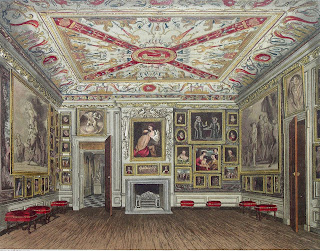
W.H. Pyne's History of Royal Residencies: 100 Fantasticly Designed Palace Interiors

William Henry Pyne (1769-1843)
Ante Chamber, Carlton House
From: The History of Royal Residences, 1819
Hand-colored aquatint engraving
11"x13"
In the early nineteenth century English interior decorative taste was heavily influenced by revival architecture and design motifs from previous centuries past. This trend of appropriating old world motifs and crafting pastiche furnishings borrowed from ancient Greece and renaissance Italy. Neoclassicism better known as England's Regency Era (1783-1837) was influenced by King George IV. Order and symmetry were two key factors in Regency aesthetic achievement, as showcased in W.H Pyne's publication The History of Royal Residencies, 1819.

William Henry Pyne (1769-1843) was a British painter, illustrator, cartoonist and writer. He was the son of textile workers, a leather seller and a weaver, but Pyne had aspirations of pursuing classic artistic endeavors. Pyne trained at the academy of Henry Pars in London and first exhibited at the Royal Academy in 1790.

Pyne's grand undertaking, The History of Royal Residences of Windsor Castle, St. James Palace, Carleton House, Kensington Palace, Hampton Court, Buckingham House and Frogmore...featured 100 commissioned hand painted aquatints of Royal interior and exterior architectural and interior design. These spectacular interior and architectural views displayed the detailed and extravagant decor of Royal peoples from iconic English palaces and landmarks.                           

W. H. Pyne
Presence Chamber, Kensington Palace
From: The History of Royal Residences, 1819
Hand-colored aquatint engraving
11"x13"
Though the publication slowly gained popularity and interest, the cost of self publishing such a extensive and artistically sophisticated book placed Pyne in financial ruin for the latter part of his life.

However, Pyne's work continues to be historically significant for documenting architectural history; such as Windsor Castle before architect Jeffrey Wyatville’s extensive alterations were made in 1824. As well as featuring St. James’s Palace,  and Carlton House; interiors created for the Prince Regent by Holland with Wyatt and Nash as architects. The History of Royal Residencies... also showcases Kensington Palace, Hampton Court, Buckingham House and Frogmore as remodeled by architect James Wyatt.
W. H. Pyne
Queen’s Audience Chamber, Windsor Castle
From: The History of Royal Residences, 1819
Hand-colored aquatint engraving
11"x13"

W. H. Pyne
King’s Writing Closet, Hampton Court
From: The History of Royal Residences, 1819
Hand-colored aquatint engraving
11"x13"

Pieces from this extravagant series of detailed Royal English households are available for purchase at Arader Galleries, 432 Jackson Street, San Francisco. Please call 415-788-5115 with any questions.

Friday, June 13, 2014

Inherent in all works of art is the notion of inspiration. The ancient Greeks attributed this phenomenon to the muses. In Christianity, the divine presence of the Holy Spirit anoints the artist with a stroke of genius. The revelation that functions as the starting point for the artist permeates the work - laying dormant, waiting for modern eyes to give it new life.

In the cultural landscape of 17th century Europe, many artists sought to represent this divine inspiration quite literally. This period, which came to be known as the Baroque, is characterized by opulence and drama. Artwork was grandiose and direct, designed to inspire piety in peasants and aristocracy alike. The term baroque, meaning a large, irregularly-shaped pearl, was attributed to art of the 17th century by 18th century critics, who disparaged the movement as absurd and grotesque – an aberration, like an irregularly-shaped pearl.[i]

The Baroque era was also a period of significant scientific and philosophical discovery. Monumental advancements in optics and measurement provided artists with new tools to more accurately represent the human experience, while Rationalist thought inspired artists to question the nature of representation.[ii] As powerhouse artists like Caravaggio and Velasquez were using novel scientific discoveries to address massive ideas about human existence, individuals like Giovanni Baptista (Battista) Ferrari (1584-1655) took on smaller, more specified pursuits of equal significance.

In line with the fashions of the time, Ferrari’s interest in orangeries – a precursor to the greenhouse – led him to produce the first scholarly study of lemons, limes, and oranges. This four-part, illustrated book about citrus was accurate and all-inclusive, touching on everything from the taxonomy to the mythology of these exotic fruits. Ferrari is noted for his imaginative compositions[iii] and scientific accuracy, which he achieved through close observation of his subject matter, made possible by scientific and technological innovations of the time. In fact, his first work, De Florum Cultura (1633), a study of ornamental plants and horticulture, includes an illustration of the seeds and seed pods of the Chinese Rose – the first ever botanical illustration produced using a microscope.[iv] As Caravaggio’s works were thought grotesque in their starkness, Ferrari’s, too, are fundamentally baroque. Ferrari presents the citrus fruit as it exists in nature, authentic and imperfect.

Giovanni Baptista (Battista) Ferrari - copperplate engraving from Hesperides sive de Malorum Aureorum Cultura et Usu Libri Quatuor (Concerning the Cultivation and Uses of the Golden Apple in Four Volumes), 1646
Giovanni Baptista (Battista) Ferrari - copperplate engraving from Hesperides sive de Malorum Aureorum Cultura et Usu Libri Quatuor (Concerning the Cultivation and Uses of the Golden Apple in Four Volumes), 1646
Influenced by the work of Ferrari, the wealthy German silk merchant, Johann Christoph Volckamer (June 7, 1644 - August 26, 1720) sought to show off his own collection of exotic citrus through his book of engravings titled, Nürbergisches Hesperides. Volckamer’s book expresses the zeitgeist of Europe in the 17th century unambiguously.  In Nürbergisches Hesperides, grotesque citrus fruits float above charming views of the gardens and palaces of Germany, Austria, and Italy[v], showcasing the Baroque architecture of the period. Volckamer’s book addresses the relationship of objects to the space they inhabit, extending the “meaning” of the citrus fruits beyond the scientific. With no source information, a viewer looking at an engraving from Nürbergisches Hesperides could identify the locale and even hypothesize about the cultural significance of the citrus depicted. For instance, one could deduce from visual clues that citrus trees were a fashionable staple of European gardens during the Baroque period[vi], and furthermore, the more monstrous the fruit, better. Visual clues reveal meaning, yet the illustration is not overtly didactic. Volckamer dissolves traditional notions of perspective, as his citrus exists neither in the foreground or the background, but is collaged on top, creating an effect that brings to mind artwork produced three centuries later by the surrealists - in particular that of Belgian artist René Magritte (1898-1967).

Johann Christoph Volckamer - copperplate engraving from Nürnbergische Hesperides, oder gründliche Beschreibung der edlen Citronat-, Citronen- und Pomeranzen-Früchte, 1708
Magritte, perversely inspired by works of the Rationalist order, utilized the aesthetics of a tradition he rejected to challenge the status quo, which he deemed oppressive. In his attempt to subvert the skeletal structure of bourgeois society, he scrambled the puzzle that Rationalist thinkers committed to solving. The aura of mystery that characterizes the Surrealist movement is achieved through Magritte’s application of symbolic non sequiturs. As Ferrari imparted the knowledge, this is an orange and these are its characteristics, Volckamer fine-tuned his achievements, adding the “where, when, and why” to his “who and what.” This empirical evidence functions as a point of departure for Magritte’s own artistic integrity as he attests of his realistic rendering of a pipe, this is not a pipe. Despite Magritte’s repudiation of history, glaring consistencies endure, including an interest in the identity of objects and a penchant for the grotesque. Magritte’s representations of the human body - distorted, amputated, veiled, and fused with other species, objects, and elements of setting – have a similar impact on the human psyche as Volckamer and Ferrari’s disfigured citrus fruits. Through imagery of the strange and unusual, our instinctive curiosity is peaked and our senses engaged, inviting us to meditate on the inspiration that motivated the work of art before our eyes.

René Magritte - La trahison des images (The Treachery of Images), 1928-29, oil on canvas
René Magritte - L'invention Collective (Collective Invention), 1935, oil on canvas

René Magritte -  Le Château des Pyrénées (The Castle of the Pyrenees), 1959, oil on canvas
René Magritte -  La Chambre d'Écoute (The Listening Room), 1952, oil on canvas
Here at Arader Galleries we have a fantastic selection of original, hand-colored engravings from the striking and historically significant works published by Volckamer and Ferrari. The plates were prepared by some of the most esteemed painters and draughtsmen of the Baroque era, including Paulus Decker, The Elder and Cornelis Bloemaert. Please contact Arader Galleries for further information.


[i] Camara, Esperança. “The Baroque: Art, Politics & Religion in 17th-century Europe.” Smarthistory at Khan Academy. Web. Accessed 4 June 2014.

[ii] Brown, Betty Ann. “Art & Mass Media: Second Edition Revised.” California State University, Northridge. 2005. Web. Accessed 4 June 2014.

[iii] DeLaurentis, Denise and Hollie Powers Holt. The Art of the Garden: Collecting Antique Botanical Prints. Atglen, PA: Schiffer, 2006. Print.

[iv] Erickson, Robert F. “Giovanni Battista Ferrari.” Rare Books from the MBG Library. Missouri Botanical Garden. Web. Accessed 4 June 2014.

[v] Blunt, Wilfrid. The Art of Botanical Illustration: An Illustrated History. New York: Dover, 1994. Print.

[vi] Kaden, Vera. The Illustration of Plants & Gardens: 1500-1850. England: Crown, 1982. Print. 

Thursday, May 16, 2013

Results of the Arader Audubon Auction, 5/11/2013

Barney Lipscomb, the Leonhardt Chair of Texas Botany at the BRIT (Botanical Research Institute Texas), renowned for his award-winning and unusual approach to bringing the science of botanical taxomony to the non-scientist 'performed' his lecture Art and Science: A Botanist's Eye: Redouté and the Art of Floral Illustration, to a full and enthusiastic house at Arader Galleries, at 29 E. 72nd Street, NYC on Friday evening. He presented a very lively look at the history and evolution of art and botanical science from the first century AD through the life of Pierre-Joseph Redouté, one of the greatest botanical illustrators and flower painters of all time, complete with slide-show and musical score, against the spectacular back drop of some of Redoute's original watercolours on vellum from his magnum opus "Les Liliacees", and John James Audubon's hand-coloured aquatints from his magnificent double-elephant folio "The Birds of America" (London, 1827-1838), all offered for public auction the following day.

Lipscomb's inspirational lecture was followed by a sumptuous dinner generously hosted by Mr. Arader at the famous Nickerbocker Club on 62nd Street, at which he honoured Professor Lipscomb for his pioneering efforts which bring the art of natural history into the classrooms of America: a cause very close to Mr. Arader's own heart, who has just donated an extraordinarily fine and comprehensive collection of works of art that reflect the history of the discovery of the natural world, and how that knowledge was brought from the new to the old world, to the University of South Carolina students studying subjects from art history to environmental science, a donation valued at $30,000,000.

Saturday's auction of hand colored aquatints from John James Audubon's magnificent double-elephant folio "The Birds of America", the single most important work on North American ornithology; hand-colored lithographs from his Imperial folio "The Viviparous Quadrupeds", the first great all-American color-plate book; and exquisitely beautiful original watercolors on vellum from Pierre-Joseph Redoute's magnum opus "Les Liliacees", conducted by Guernsey’s at Arader Galleries at 72nd Street, in New York, this last Saturday, was a triumph, for Arader Galleries and for the universities that Mr. Arader supports through his philanthropic educational programs , as 20% of the hammer price of each lot sold will be donated to one of these programs, or a charity of the purchaser's choice.

More than one third of the plates from the original publications of "Birds of America" and "The Viviparous Quadrupeds" went under the hammer and were more than 85% sold by lot. Not surprisingly some exceptionally high prices were achieved for some iconic images: $100,000 for plate number, and lot number, one "The Male Turkey"; $110,000 for the "Snowy Owl"; and $90,000 for the Long-Billed Curlew. The normally tranquil Arader Gallery at 72nd Street, was buzzing with more than 125 potential private and institutional bidders jostling for standing room only, as many of the other 230 lots sold for well over their high estimates. Arader Galleries retains a comprehensive gallery of works of art by both Audubon and Redoute, and we welcome all visitors at our galleries in New York, Philadelphia, Houston and San Francisco, or to our website www.aradernyc.com.

At this point cash gifts to Arader Galleries' Client's charities appear to be headed well over $400,000 as a result of giving programs established by this auction. The idea of all auctions generating a minimum of a 10% of hammer donation to the buyer's charity makes sense and is clearly being embraced by collectors. The art museums, libraries and 3600 four year colleges in the United States that create interest in fine art and the decorative arts should be rewarded for creating and maintaining the interest in collecting that is such a major fabric in American life today. 

Thursday, January 10, 2013

Arader Galleries Presents: the Shaping of San Francisco


W. Vallace Gray and Charles B. Gifford
"Bird's Eye View of the City and County of San Francisco, 1868"
San Francisco: 1868-69
Hand-tinted lithograph

Please join Arader Galleries for a very special evening with Mr. Charles Fracchia

Arader Galleries is pleased to be hosting Mr. Charles Fracchia for the final segment of his 3-Part Lecture Series "The Shaping of San Francisco" on the evening of Tuesday, January 22 at 6:15 pm where he will be presenting Part 3:

The Shaping of San Francisco.
Part 1: The Spanish Mexican Period (September 20th)
Part 2: The Gold Rush (October 17th)
Part 3: The Silver Age (January 22nd)

Charles Fracchia is the Founder and President of The San Francisco Historical Society and is passionate about San Francisco's extraordinary history.

Arader Galleries in Jackson Square's historic district, is the perfect backdrop to host this lecture, as many of the Gold Rush-era commercial buildings in the Jackson Square area managed to escape the 1906 earthquake. The lectures will take place at our beautiful building at 432 Jackson Street.

This lecture is free to attend. Please RSVP by calling the gallery at (415) 788-5115, availability is limited!

We will look forward to seeing you!

The Arader Galleries Team

Wednesday, July 11, 2012

Edward Lear- artist, illustrator, author, poet


Edward Lear (12 May 1812 – 29 January 1888) was born in Halloway, England to a middle class family. As the second-to-last of twenty-one children, he was raised by his oldest sister, Ann, due to poor family finances. Lear also suffered from epilepsy and asthma from an early age - illnesses that would plague him his entire life. Lear became a paid artist at the age of 16 when he took a job with the Zoological Society as a “ornithological draughtsman.” He continued his work drawing the private menagerie of the Earl of Derby. His publication, Illustrations of the Family of Psittacidea, or Parrots, came about in 1830, when the artist was 18. His work was favorably received and compared to contemporary artists such as John James Audubon. At the age of 25, failing eyesight caused Lear to give up his detailed ornithological work. He moved to Rome in 1837 in an attempt to bolster his poor health.

For the next 50 years, Lear would travel all over the world exploring; supporting himself through his drawings, watercolors, and writings. His travels included forays in Greece, Palestine, Egypt, India and Ceylon (modern-day Sri Lanka). While traveling he produced numerous colored wash drawings that he would later build up with watercolor and oil. To share his experiences, Lear kept detailed journals documenting his day–to-day experiences and sketched the local topography. He later annotated his journals, letters, and sketches often purposely misspelling words and adding nonsensical phrases for publication.

Courtesy of 

The Project Gutenberg eBook, A Book of Nonsense, by Edward Lear

Lear passed away at his Italian villa in 1887 from heart disease. Sadly, none of his friends were able to attend the funeral.


Great Britain marked the centennial of his death with a set of Royal Stamps in 1988 and an exhibition at the Royal Academy. To mark the bicentennial of his birth, a range of events have been planned throughout the world on May 18 – International Owl and Pussycat Day – including a Google Doodle depicting the titular Owl and the Pussycat.

Arader Galleries is please to present a rare first edition of Lear’s Illustrations of the Family of Psittacidea, or Parrots. This publication marked the transition from engraving to lithography in natural history works. This work contains 42 lithographs with original hand-painted color. A run of only 175 books were produced, of which only 100 survive today. The quality of this work established Lear’s reputation as one of the best natural history artists of his time.

Edward Lear (1812-1888)
Illustrations of the Family of Psittacidae, or Parrots
London: Edward Lear, 1830-1832
Hardcover
Book Condition: Near Fine
Folio (21 x 14 inches)
Letterpress title-page, dedication leaf, list of subscribers, list of plates,
42 fine hand-colored lithographic plates by and after Lear.
Fine modern half diced calf marbled boards antique,
Please contact Arader Galleries for further details.

Monday, January 16, 2012

The Age of Discovery at Arader Galleries

Arader Galleries in San Francisco was thrilled to host Mrs. Deborah Krikorian’s 7th grade class from San Francisco's Waldorf School last Friday, January 16th. For the second consecutive year, Gallery Director Nicole Lopez presented an insightful lecture focused on the history of cartography and map making during the Age of Discovery (16th through 19th centuries) coinciding with the students’ in-class curriculum.

Students were shown maps and discussed the changing shape of the world as cartographers continued to explore and record their findings throughout the 16th to 19th centuries. Viewing these maps brought to life previous history lessons and stories of explorers traveling the unknown for the students.

Thursday, November 17, 2011

Season's Greetings from Arader Galleries

As the holiday season draws near, the quest to find the perfect gift begins!

Please stop by Arader Galleries throughout the holiday season to view our
impressive collection of 
original maps, engravings,
lithographs, and watercolors.

Hours:

Monday - Friday 10am - 6pm
Saturday 11am - 5pm

Holiday Hours:

December 24th (Christmas Eve) - 11am - 3pm
December 25th - Merry Christmas!
December 26th - Closed
December 31 - Closed
January 1st - Happy New Year!
January 2 - Closed

Tuesday, November 15, 2011

An interview with Graham Arader

Photograph by Ben Hoffmann

ForbesLife Magazine conducted an insightful interview with Graham Arader about his 40-plus years of experience in the map and rare book world. Beginning with a tour of the Rare Books Vault located in the New York Gallery, Mr. Arader presents an inside view into his world of collecting and dealing rare maps, books and prints and discusses those in his profession who have taken their love for rare maps too far.

"Maps combine art, power, psychology, history, commerce, and fantasy" states Mr. Arader from his gallery at 29th East 72nd Street in New York City. Mr. Arader began his business while in college at Yale. He was captain of the squash team and all–Ivy League for three years--but his life changed when he met Alexander Orr Vietor, the curator of Yale's map collection. "I am the only guy in history who used Yale as a trade school," Arader says. "Mr. Vietor let me use his personal reference library and taught me the standards of collecting. I sold $100,000 in maps my senior year in college.”

With an extensive collection of maps, globes, natural history and botanical prints and great love of history, Mr. Arader has amassed an inventory of over $600 million, spread throughout his five galleries nation-wide. He has also seen first hand the underside of the dealing world and has worked with the FBI and government agencies to capture and convict map and rare book thieves.

With no plans of stopping anytime soon, Mr. Arader continues to collect, deal and make charitable contributions to schools and organizations, hoping to entice and educate the public about these rare and fascinating pieces of history. As he dutifully states, “They tell history in a way you can't get in any other art form.”

To read the full interview, please visit: ForbesLife Magazine

Thursday, November 10, 2011

Building Blocks for Education

Arader Galleries is proud to announce that its founder and namesake, W. Graham Arader has gifted Northeastern University a number of historically significant maps, engravings, woodcuts and botanical watercolors. The Arader Galleries Collection is on display at Snell Library, and the pieces have been incorporated into a new course, “Picturing the World,” introduced by Georges Van Den Abbeele, founding dean of the College of Social Studies and Humanities and is co-instructed by English professor Beryl Schlossman.

“The Arader Galleries Collection has enhanced our course in a tremendous way,” said Dean Van Den Abbeele. “By giving students access to these works, we have quite literally brought history into the classroom. The pieces we’ve acquired from the nation’s leading expert on historically significant maps underscore Mr. Arader’s support of cultural institutions and his commitment to making these bits of history available to a greater audience.

“Dean Van Den Abbeele and Professor Schlossman have created an innovative curriculum that delves deeply into the historic relationships between early exploration and trade, and the beauty and science of nature, technology and art,” Arader said. “Arader Galleries and I are thrilled to provide Northeastern University with these important works so students can see firsthand their beauty and understand their historic importance.”

Friday, October 21, 2011

San Francisco Fall Antiques Show

View of Hong Kong Island
Chinese, c. 1845-1855

Gouche on pith paper


Ernst Friedrich Carl Lang (1748-1782)
Gouache on vellum ornithological painting

Arader Galleries is happy to announce that we will be participating in the San Francisco Fall Antiques show this year!


The San Francisco Fall Antiques Shows runs from October 27th to the 30th, 2011 at the Festival Pavilion at Fort Mason. Tickets to the San Francisco Fall Antiques show may be purchased at http://www.sffas.org.
We hope you will stop by to see our extraordinary collection of antique prints, maps and original watercolors!

Festival Pavilion at Fort Mason, San Francisco

October 27 to October 30, 2011

Thursday - Saturday, 10:30 a.m. to 7 p.m.

Sunday, Noon to 5 p.m.

Monday, May 16, 2011

Arader Galleries Charity Auction

It is a great pleasure to announce Arader Galleries third annual charity auction in New Orleans where 20% of the hammer price goes to the institution of your choice. Over the last three years Arader Galleries has proudly raised over $2,000,000 for over 25 deserving schools, hospitals, settlement houses, libraries and academic institutions that are so important to our clients.

The auction will be held on June 25th and 26th, 2011 and will include over 65 of John James Audubon’s iconic aquatints from the Elephant folio Birds of America, published in London by Robert Havell between 1826 and 1838. The aquatints of birds by John James Audubon are true masterpieces of natural history art from the last 500 years and the iconic images are brilliant in their flawless artistic composition, the way they depict the life and movement of the bird, as well as providing scientifically accurate Linnaean detail.

Other highlights of the auction are the first imperial folio edition of Audubon's famous work The Viviparous Quadrupeds of North America, complete in three volumes and with 150 fine hand-colored lithographed plates, and works from other 19th-century natural history artists including John Gould, Daniel G. Elliot and John Robert Thornton. A selection of fine maps and other color plate books from our collection will also be included.

We have chosen Neal Auction House to hold this auction because they have always been honest, helpful and accurate in their transactions with us over the last 15 years. We assure you that all purchases made by you at the sale will be delivered to you promptly, professionally, and at the lowest possible price. Also as a bonus please note that most of these pieces have been framed in elegant gold leaf moldings to full museum specifications.

Please let us know if you would like more information or would like to be sent a complimentary auction catalog.

Wednesday, March 30, 2011

Los Angeles Antiques Show


Arader Galleries is happy to announce that we will be participating in the Los Angeles Antiques show this year!

We hope you will stop by to see our extraordinary collection of antique prints and original watercolors!

The Los Angeles Antiques Show
Held at the Barker Hangar at the Santa Monica Air Center

Opening night Preview Party
Wednesday April 13 benefiting P.S. Arts

Show Dates/Times
April 14 - 17, 2010
Thursday 11am - 7pm
Friday 11am - 9pm
Saturday 11am - 7 pm
Sunday 11am - 5pm

For information on the Los Angeles Antiques show, and the lecture series, please visit www.losangelesantiqueshow.com.

Wednesday, February 16, 2011

Arader Galleries presents a syndication of John Gould's "A Monograph of the Trochilidae - the Hummingbirds"

Topaza Pella -
Crimson Topaz


Cometes Sparganurus - The Sapphro Comet

Arader Galleries is pleased to announce a syndicated distribution of authentic hand-colored lithographs from John Gould's
most famous work:
A Monograph of the Trochilidae - the Hummingbirds. These beloved images were published between
1849 and 1881, based on specimens in Gould's own magnificent collection and from his travels.

These engravings are renowned for their use of mineral inks that duplicate the natural iridescence that makes these birds so special. This is the finest natural history coloring of all time, nothing else before or since compares. These 418 beautiful, hand colored lithographs in superb condition will be distributed at 1:00 pm on March 12, 2011 at our gallery in New York
at 1016 Madison Avenue.

A syndication is a wonderful opportunity to build or add to a collection at tremendously discounted price. 83 shares consisting of five lithographs are available at $4,800, or $960 each. The order of selection will be determined in
three rounds by a random lottery.

For more information about the John Gould hummingbird syndication,
please contact our San Francisco gallery at (415) 788-5115.