Monday, April 25, 2016


The Hillsborough Spring Antique, Art + Design Showcase is right around the corner! Please join us this weekend for an amazing selection of the finest  Bay Area Art and Antiques at the San Mateo Event Center.

We will be displaying our renowned collection of Audubon Quadrupeds, California maps and views, as well as botanicals from Pierre-Joseph Redoute, and Mercator and Ortelius Maps to name a few.

Tickets are $10.00 and can be purchased online. 

April 29- May 1
Friday April 29th        11am-7pm

Saturday April 30th     11am-6pm

Sunday May 1st           11am-5pm


For further gallery inquiries and purchases please contact us at (415) 788-5115, or visit Arader Galleries 432 Jackson Street, San Francisco, Ca 94111.

Sunday, April 17, 2016

Zoological Illustrations by Cuvier and Saint-Hilaire

Cuvier and Saint-Hilaire
 Mandrill Male
Lithograph
20"x13"
The works from Histoire Naturelle Des Mammiferes, Avec Les figures Originales.d'aprs Des Animaux Vivians, 1824-42 was crafted by a friendship that introduced the French zoological and natural history community with the finest illustrations of exotic mammals. These lithographs captured the movement and personality of the animal while depicting scientifically accurate compositions. Similar innovation as to the design and depiction of mammals could be compared to the works of acclaimed American ornithologist John James Audubon (1785-1851).

Frederic Cuvier (1769-1832) was a French zoologist and paleontologist who worked for the Museum d'histoire Naturelles in Paris, while  Geoffroy Saint-Hilaire (1772-1844) was a French naturalist and evolutionary theorist. The two met in 1794 and formed a close friendship shortly after. This friendship lead to the creation of a great feet, the production of Five memoirs on natural history, one of which was a study on the classification of mammals. 
Cuvier and Saint-Hilaire
Renard Argente
Lithograph
18"x12"
The original publication of  Histoire Naturelle Des Mammiferes, Avec Les figures Originales.d'aprs Des Animaux Vivians was intended to have 72 parts to be bound in 7 volumes. This publication was made in conjunction with the Museum d'Histoire Naturelles in Paris. Most of the animals were drawn from life at the Paris Zoo Jardin de Plantes. Cuvier provided descriptions for each mammal while Hilaire edited the work and  provided additional articles.  
Cuvier and Saint-Hilaire
Kiodote
Lithograph
20"x13"
For purchase inquiries please call 415-788-5115, or feel free to stop by Arader Galleries, at 435 Jackson Street, San Francisco. 

Monday, April 11, 2016

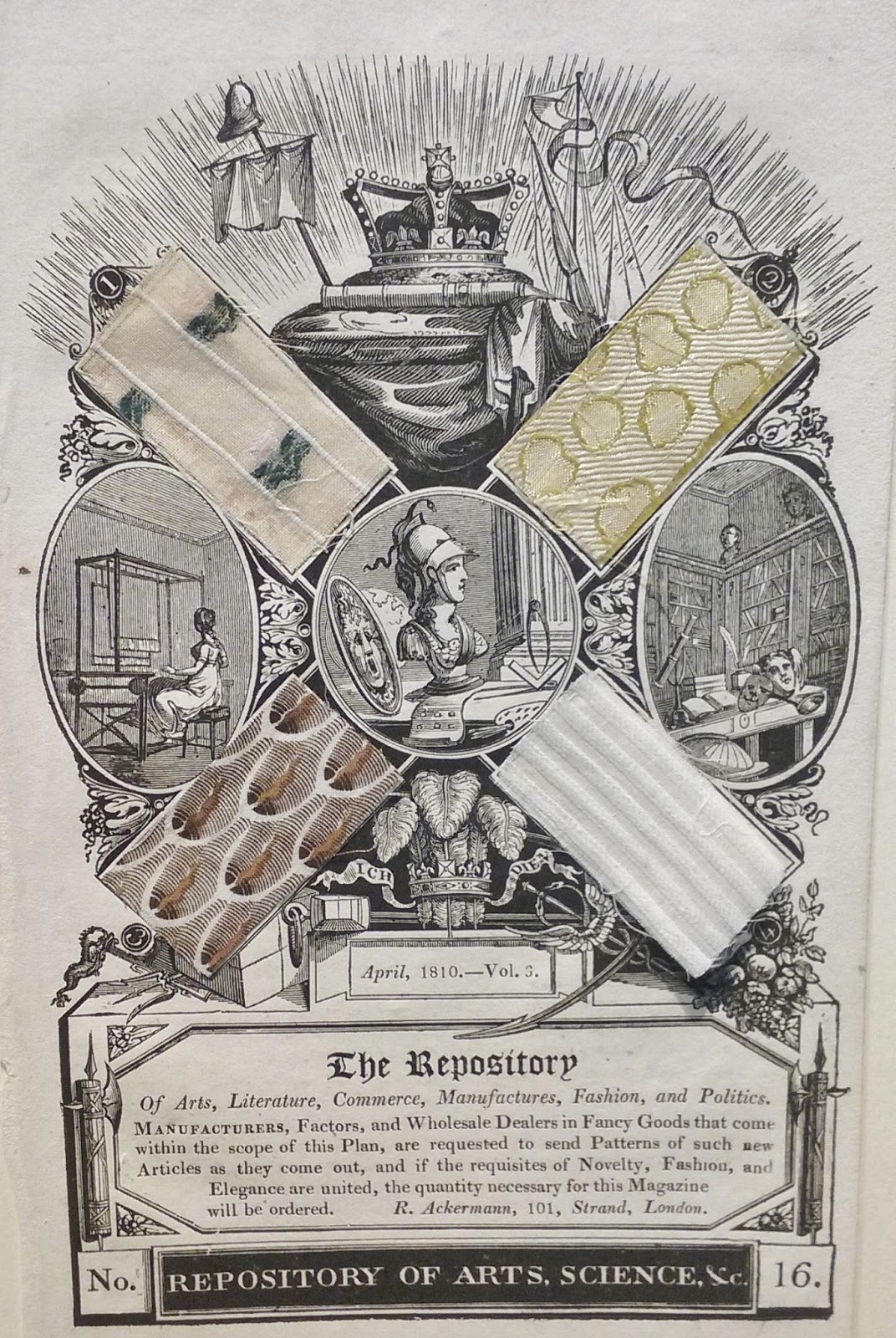
Ackermann's Repository: Allegorical Textile Woodcuts from Regency England


R. Ackermann
No.16
 c.1810-1813
Woodcut engraving with Fabric Samples
One of the many people who took advantage of England's industrial age was a printmaking entrepreneur named Rudolph Ackermann (1764-1834), an Anglo-German bookseller, inventory, lithographer and publisher. Among other things he was also a successful shop owner, his store the Repository of Arts opened in 1797 and became a spot for the English elite to socialize and shop for prints, illustrated books, decorative objects, art supplies, old master paintings and miniatures.

Ackermann extended his shop and created a yearly publication that showcased British manufacturing, in 1809 he began publishing his serious The Repository of Arts, Literature, Commerce, Manufacturers, Fashions ad PoliticsAckermann's Repository, as it was also known, influenced English fashion, tastes, architecture, politics and literature throughout the Regency period and into the Georgian Era.
 R. Ackermann
No. 17
 c.1810-1813
Woodcut engraving with Fabric Samples
In an effort to boost British manufacturing and commerce, Ackermann included textile samples from premiere manufacturers. These woodcut engraving showcased real fabric samples that were adhered to the engraving. These fabric swatches appealed to fashion lovers and those who furnishing and designing their homes. On the next page the fabric swatches are described and note its designed cultural influences. The pieces of fabric stand out again an allegorical background, featuring a woman at her loom, a bust of Athena and her shield of Medusa near the Freemason's symbol the compass and square. And to the far right  a library filled with busts, books, and other minute cultural references. Mast sails peak out of the background, floating around a German Imperial Crown. Below features the symbol of the prince of whales, an emblem of the British Monarchy, a crown with silver ostrich feathers. Perhaps these crowns are featured because of Ackermann's cultural heritage.

Interestingly The Repository's last issue in 1829 was a dedicated fashion issue. Though Ackermann's shop closed and his Repository issues ended, his print making legacy was carried on by his decedents till the late 20th century.

A selection of Ackermann's Repository Textile Woodcuts will be featured in our under $300 section at the Hillsborough Spring Antique Show April 29-May 1. These works will be accompanied by our magnificent Audubon quadrupeds, Redoute flowers, Double Hemisphere projections, and California maps.

Feel free to can contact the gallery at (415)-788-5115.
Aader Galleries 432 Jackson Street, San Francisco, Ca, 94111

Sunday, April 3, 2016

The Oakes Ames Orchid Watercolor Collection Exhibited at Filoli April 5th-June 12th

Charles Storer
Cypripedium Curtisii, 1898
Original Watercolor
13 7/8" x 9 7/8"
We are excited to announce our presence at Filoli's Annual Botanial Art Exhibition from April 5th-June 12th showcasing the gallery's fine original watercolor works from Oakes Ames' Orchid Collection.

Artist Reception

Thursday, April 7, 5:00 pm – 7:00 pm
For ticket and reservations: Click Here

Filoli is a "654–acre property, including the 36,000 square foot Georgian country house and spectacular 16–acre English Renaissance garden. Admission to Filoli allows visitors to explore the historic House and Garden at their leisure. The Filoli Botanical Art Exhibit has long been an essential part of our Botanical Art Program’s mission to interpret and preserve this historically significant art form. With its exquisite formal Garden, heirloom orchard and nature preserve, Filoli is a unique and fitting venue for this historical art form that has rendered plants throughout history and from around the world.  In the historic House a collection of botanical illustrations will be on display in the elegant Ballroom and select pieces will be displayed in the Trophy Room."

Orchids and Oakes Ames
Blanche Ames
Cypripedium Kimballianum, 1900
Original Watercolor
14" x 10"
The incredible Oakes Ames collection of watercolor orchids was gifted to the Massachusetts Horticultural Society by famed botanist Oakes Ames (1874 - 1950). Through his life’s work on the orchid family, he and his wife Blanche unveiled the mysteries of this strangely beautiful plant species to the rest of the world. These gorgeous and delicate watercolors were part of Ames’ personal collection of orchid paintings, featuring works by the botanist himself, his wife Blanche, Charles Storer, J.L. Macfarlane, Putzys, and several by unidentified artists.  As part of his exhaustive research on orchids, Ames made expeditions to Florida, the Caribbean, the Philippines, and Central and South America with his wife, creating scientific drawings and watercolors of each plant they cataloged. The Ames' work was published in the seven-volume Orchidicae: Illustrations and Studies of the Family Orchidicae. 

To purchase Ames' watercolors you see at Filoli  please call 415-788-5115. 
Arader Galleries, at 435 Jackson Street, San Francisco. 


Sunday, March 27, 2016

From Sea to Shining Sea: Karl Bodmer's American Expedition

Embouchure de Fox-River
23 ¼ x 17 ½
Karl Bodmer's is known for his magnificent series of ethnographic accounts of Plains Indian culture during the time of 19th century western expansion. Bodmer was an unassuming Swiss painter when he was chosen by Prince Maximilian of Prussia to accompany his voyage to America, in order to document in pictorial terms his expedition. With the rest of Maximilian’s company, the two traveled among the Plains Indians from 1832 to 1834, a time when the Plains and the Rockies were still virtually unknown. The Bodmer/Maximilian collaboration produced a record of their expedition that is incontestably the finest early graphic study of the Plains tribes. Together the documented writing of Maximilian’s travels coupled with the iconic scenes of the West produced the seminal publication Travels in the Interior of North America, 1832-1843


Though Bodmer is most noted for his ethnographic drawing and paintings of the Plains Indians but his scenes of the North American views captured the mystique and majesty of the vast and diverse American  landscape. Maximilian and Bodmer journeyed from St. Louis up the Missouri River on the American Fur Company steamboat “Yellowstone,” stopping at a series of forts built by the Fur Company and meeting their first Indians at Bellevue. The travelers continued  to Fort Union, Fort Clark, and Fort Mackenzie, which proved to be the western most point of their journey. After living among and studying the Blackfeet tribe for several weeks, Maximilian decided that it was too dangerous to continue, so the travelers returned southward, reaching St. Louis in May 1834.

 Forest Scene of the Lehigh
23 ½" x 17 ½"

Cleveland Lighthouse
17 ½" x 12"
Once the journey was over, Bodmer spent four years in Paris supervising the production of the aquatints made from his drawings.These spectacular and atmospheric images are important and beautiful records of the landscape of the American West as it appeared when Bodmer saw it, just before westward expansion and industrialization took hold and began the indelible transformation of the frontier.

Junction of the Yellowstone River with the Missouri
24" x18"
A Selection of Bodmer's North American Views and Ethnographic works are available for purchase at Arader Galleries 432 Jackson St. San Francisco, CA 94111 
Please call 415-788-5115 with any questions

Sunday, March 20, 2016

W.H. Pyne's History of Royal Residencies: 100 Fantasticly Designed Palace Interiors

William Henry Pyne (1769-1843)
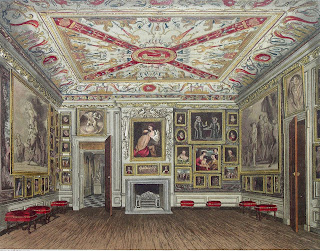
Ante Chamber, Carlton House
From: The History of Royal Residences, 1819
Hand-colored aquatint engraving
11"x13"
In the early nineteenth century English interior decorative taste was heavily influenced by revival architecture and design motifs from previous centuries past. This trend of appropriating old world motifs and crafting pastiche furnishings borrowed from ancient Greece and renaissance Italy. Neoclassicism better known as England's Regency Era (1783-1837) was influenced by King George IV. Order and symmetry were two key factors in Regency aesthetic achievement, as showcased in W.H Pyne's publication The History of Royal Residencies, 1819.

William Henry Pyne (1769-1843) was a British painter, illustrator, cartoonist and writer. He was the son of textile workers, a leather seller and a weaver, but Pyne had aspirations of pursuing classic artistic endeavors. Pyne trained at the academy of Henry Pars in London and first exhibited at the Royal Academy in 1790.

Pyne's grand undertaking, The History of Royal Residences of Windsor Castle, St. James Palace, Carleton House, Kensington Palace, Hampton Court, Buckingham House and Frogmore...featured 100 commissioned hand painted aquatints of Royal interior and exterior architectural and interior design. These spectacular interior and architectural views displayed the detailed and extravagant decor of Royal peoples from iconic English palaces and landmarks.                           

W. H. Pyne
Presence Chamber, Kensington Palace
From: The History of Royal Residences, 1819
Hand-colored aquatint engraving
11"x13"
Though the publication slowly gained popularity and interest, the cost of self publishing such a extensive and artistically sophisticated book placed Pyne in financial ruin for the latter part of his life.

However, Pyne's work continues to be historically significant for documenting architectural history; such as Windsor Castle before architect Jeffrey Wyatville’s extensive alterations were made in 1824. As well as featuring St. James’s Palace,  and Carlton House; interiors created for the Prince Regent by Holland with Wyatt and Nash as architects. The History of Royal Residencies... also showcases Kensington Palace, Hampton Court, Buckingham House and Frogmore as remodeled by architect James Wyatt.
W. H. Pyne
Queen’s Audience Chamber, Windsor Castle
From: The History of Royal Residences, 1819
Hand-colored aquatint engraving
11"x13"

W. H. Pyne
King’s Writing Closet, Hampton Court
From: The History of Royal Residences, 1819
Hand-colored aquatint engraving
11"x13"

Pieces from this extravagant series of detailed Royal English households are available for purchase at Arader Galleries, 432 Jackson Street, San Francisco. Please call 415-788-5115 with any questions.

Wednesday, August 26, 2015

Recreating Paintings in 'The Temple of Flora'

Robert John Thornton (circa 1768-1837)
The Queen
1804
 Aquatint, mezzotint and stipple engravings finished by hand
Painter- Peter Henderson
Thornton’s Temple of Flora combines the scientific with the artistic. The images portray the worlds most exotic flowers and plants at the time placed into vast mountainous landscapes creating an overall spectacular sight for viewers. Thornton worked with various painters to create the images in paint, then with the help of engraver James Caldwell to recreate them in print using Intaglio printing methods.

Intaglio, coming from the Italian word intaglione, is an ancient printmaking process dating back to 400 B.C. in which ink is applied to a copper or zinc plate, wiped off the surface than printed under high pressure. Ink that remains in the grooves of the plate is transferred onto the paper from the pressure of the press. These grooves can be physically scratched into the plate via dry point engraving or etched using feric acid. 

Mezzotint, in addition to engraving and aquatint methods, were used to achieve gradation without the use of line or crosshatching. This is a method where the engraver uses a tool called a ‘Roulette’ to make small repeating dots or lines, creating the illusion of shadow and/or light. Small rotating teeth create grooves in the plate for ink to hold which then transfers to paper when run through a high pressure printing press. All of the prints in Thornton's ‘Temple of Flora’ were hand water-colored after printed to get a full range of color. The prints displayed are from Thornton's Temple of Flora, each one painted by a different artist then re rendered on copper using various methods to replicate the depth and color range of the original. 

Aquatint refers to the process of etching the copper plate with acid instead of physically removing material. The ‘etcher’ prepares the plate with a dusting of fine resin, and then heats the plate to fix the small particles. These small particles act as a stop out to the acid which creates tonal regions on the plate. Areas that touch acid will be etched and will have a tone. The longer the plate is in the acid for, the darker the tone. States or stages of aquatint can be added to create multiple shades of color or tones.

Robert John Thornton  (circa 1768-1837)
The Blue Passion Flower
1800
Aquatint, mezzotint and stipple engravings finished by hand
Painter- Philip Reinagle
Robert John Thornton (circa 1768-1837)
The Persian Cyclamen
1804
 Aquatint, mezzotint and stipple engravings finished by hand
Painter- Abraham Pether (1731-1795)