Wednesday, August 15, 2012

Besler's 'Hortus Eystettensis'


Basil Besler (1591-1629) was an apothecary and botanist from Nuremberg, who managed the gardens of Prince-Bishop Johann Conrad von Gemmingen (approx. 1561-1612) in Eichstatt, Bavaria. The Prince-Bishop’s remarkable garden was one of the most extensive in Europe, containing a huge variety of European shrubs and flowering plants as well as exotic specimens from Asia and the Americas. Besler was commissioned by the Prince-Bishop to compile a codex of the plans in his garden. This encyclopedic resource became the basis for the Hortus Eystettensis (Garden at Eichstätt) which took sixteen years to complete (the Biship died shortly before  printing) and was published in 1613 by Basil Besler and Ludwig Jungermann. The work contains 1086 illustrations of plants from 367 copperplate engravings, most of which were depicted in their natural size. The copperplates were engraved by a group of skilled German draughtsmen and artists including Wolfgang Kilian, Dominicus Custos, and Levin and Friedrich van Hulsen and according to the oversight and drawings by Basilius Besler. The accompanying descriptive text was written primarily by botanist Ludwig Jungermann (1572–1653).


Published one hundred and fifty years before Linnaeus created his thorough system of classification, Besler’s great florilegium represents an impressive early attempt to classify plants for the benefit of botanists, doctors, and apothecaries. Each plant is given a distinct and often descriptive Latin title, and related species are grouped together on the same plate, or over a series of plates. Almost all specimens are shown complete and accurately colored, including delineations of their root systems. While Besler’s work is obviously motivated by a scientific impulse to document and describe a remarkable collection of species, the beautiful presentation and dramatic stylization of the illustrations also convey a sense of the visual grandeur of the Bishop’s great garden. Each specimen is placed on the page with an artist’s understanding of formal and spatial relations. Most notably, the stylized depiction of foliage and root systems betrays a lively baroque sensibility, as the plants seem to dance across the page.


Basil Besler’s great botanical work is a landmark of botanical documentation and pre-Linnaean classification, as well as one of the most splendidly stylized and aesthetically powerful botanical works ever produced.


The work was published twice more in Nuremberg in 1640 and 1713, using the same plates, plates which were destroyed by the Royal Mint of Munich in 1817.
Sadly, the original Eichstatt gardens were sacked by invading Swedish troops under Herzog Bernhard von Weimar in 1633-4; however reconstructed gardens were opened to the public in 1998.

French botanist Charles Plumier honored Besler posthumously by naming a climbing bush Beseleria.

These illustrations of various flowers are among the most dramatic and desirable of Besler’s illustrations. Each is in excellent condition, and would represent wonderful additions to any collection of European botanical art. Please contact Arader Galleries for further information.


Wednesday, August 8, 2012

Today in History: August 8th


 British naval officer Joseph Whidbey led an expedition to search for the Northwest Passage near Juneau, Alaska as part of Captain Vancouver’s expedition of the American Pacific Northwest.

A veteran of the American war for Independence, Whidbey was given a peacetime appointment aboard the HMS Europa, where he conducted detailed surveys of Port Royal with then-Lieutenant Vancouver. Once his berth was completed, he was commissioned to the HMS Discovery along with Vancouver.

George Vancouver was born in King's Lynn, Norfolk, England on June 22, 1757. He began his naval career aboard the HMS Resolution, captained by James Cook. Upon completion of two voyages with Captain Cook, Vancouver was commissioned as a Lieutenant aboard the HMS Martin surveying coast lines. It is this work that would set him apart from his peers. Following the Nootka Crisis - which resulted in skirmishes between the Spanish and the English as both tried to assert their authority over the territory - Captain Vancouver was given command of the Discovery and the Chatham and charged with the task of surveying the Pacific Northwest coastline.

The mission was time-consuming as the ships Discovery and the Chatham were too cumbersome to fit into the lithe channels and inlets along the coastline; instead, small boats were sent in every direction to examine the coast in detail. The Vancouver Voyage lasted four-and-a-half years, circumnavigating the globe, landing in five continents and had a great and lasting affect on the indigenous people it encountered as well as encouraging colonization of the Americas.
 
Captain George Vancouver’s maps were so great in detail that they were used as the key reference in coastal navigation for generations to come. In addition to his contributions to navigational records of the Pacific Northwest, he also contributed many surveys of Australia, Galapagos Islands, Sandwich Islands, Mexico, and Chile.

To recognize Whidbey’s outstanding service, Captain Vancouver named the island that forms the northern boundary of Puget Sound -incidentally named for another navel officer on the Vancouver expedition - Whidbey Island.


 Arader Galleries is proud to offer you a fine selection of Vancouver Expedition survey maps. Please contact the Gallery for more information.


Tuesday, August 7, 2012

Grecian Themed Art Just in Time for the Olymplics


With the 2012 London Olympics just over half-completed, Arader Galleries thought it was high time to show our Olympic spirit. Sport, like art, brings together people of all classes, creeds, and countries to remind us that at our very core we are the same.


Sir William Hamilton (1731-1803) was sent to Naples as Chief British Envoy to the Bourbon King Ferdinand IV. Once there, he was inspired by the cultural heritage of Italy and began studying archaeology and antiquity; he soon embarked on a project to publish illustrations of the objects that so fascinated him. Hamilton assembled perhaps the finest collection of ancient Greek ceramics found in Italy, and then chose the finest examples for his publication, Collection of Etruscan, Greek and Roman Antiquities (Naples, 1766-67). Hamilton saw his mission as one to remind Europe of the beauty of form and lines and to “annihilate those Gothic forms which habit alone renders supportable.”

Hamilton’s Collection of Etruscan, Greek and Roman Antiquities contained two kinds of illustrations: First, narrative and pictorial plates, each one with decorative motifs taken from a vase, cup, or plate; and second, black and white perspective drawings of the pieces so that artists and craftsmen could recreate the ancient forms.  The narrative plates exhibit the classical black and terra-cotta color scheme, with touches of accent coloring on some of the plates. The subject matter ranges - as it did on the original ceramic pieces - from activities of the mythical gods and creatures, to feasting and the daily life of ancient peoples. The black–and-white perspective drawings were intended to provide guidelines to artists “with as much truth and precision as if he had the Originals themselves in his possession.”
 
For his tireless research in the fields of volcanism, archaeology, antiquity, and Italian geography, Hamilton was elected a Fellow of the Royal Society as well as awarded the Copley Medal in 1770 for his paper, An Account of a Journey to Mount Etna. His book, Collection of Etruscan, Greek and Roman Antiquities, became a virtual dictionary of Classical form throughout the l8th and l9th centuries. His collection became a cornerstone of the British Museum’s Department of Classical Antiquities.

It is in this Grecian spirit that Arader Galleries is pleased to provide a collection of Hamilton prints.
 For more information or inquiries, please contact the gallery. 


Wednesday, August 1, 2012

Interests Turned Collections

George Arents, Jr. was the grand-nephew of Major Lewis Ginter of Allen and Ginter tobacco manufacturing company, later acquired by the American Tobacco Company. With a Bachelors from Columbia University (and a  Masters degree at Syracuse University at the age of 57), Arents joined the family business and served as a member of the American Tobacco Company firm from 1896 to 1905. In 1922, he became a director and, from 1924 on, the treasurer of both the American Machine and Foundry and International Cigar Machinery, a subsidiary. For his contributions, Arents is considered one of the founders of the American Machine and Foundry. With his partner Rufus L. Patterson, Arents received a patent on a cigar-rolling machine in 1900 and eventually they produced two-thirds of the cigars manufactured in the United States.

In conversation with Sue Dickenson of Commonwealth Magazine, Arents recalled a talk given at the College of William and Mary in 1939 where he discussed some advice his great-uncle once gave him:

“On one of my many visits, Major Ginter gave me some advice which I have never forgotten; it has added greatly to my happiness and I think may be of value to many of you here – he said, ’When you are young, have many hobbies, but let your business or profession come first; as you grow older, you will have to abandon some of them, the more you have, the less you will miss those you have to give up.”

Image Courtesy of Wikicomons
In 1893 Arents purchased a pamphlet entitled “A Pinch of Snuff” for $2.25 while perusing an antique bookshop. This was the start of what would become a lifelong passion - as well as the largest and most important collection of tobacciana in the world. Perhaps the most noteworthy item in his tobacco collection is the vary rare 1507 volume of Cosmographiae Introductio by Martin Waldesmuller. As the first printed reference to tobacco, it cites an account of explorer Amerigo Vespucci having observed Native Americans chewing a certain green plant. Arents continued to collect books, images, and other paraphernalia that referenced tobacco. By 1952, five illustrated volumes were published on the collection: Tobacco, its History Illustrated by Books, Manuscripts, and Engravings in the Library of George Arents, Jr.


Rosa Macrocarpa
from Redoute's Les Roses
Arents’ other great contribution, The George Arents Collection of Books in Parts, contains over 1,200 items dating from the 18th to the 20th centuries and is one of the most important collections assembled on the subject. In the words of Sarah Augusta Dickson, the first curator of the George Arents Collection: “Books in parts may be defined as works by an author or authors which are published piecemeal over a period of time, each unit having its separate cover, usually paper or boards, and in many cases with the title-page and other preliminary matter for the volume or volumes at the end of the last part.” These items were acquired with a keen eye intent on collecting only the best copies of these publications with an emphasis on original condition and original wrapping. Several titles in bindings were added to the collection including Redouté's Les Roses and Audubon's Birds of America (the octavo edition of 1840-1844).

Californian Partridge
from Birds of America
John  James Audubon
George Arents, Jr.’s other interests included auto-racing, music, books, and sports. In 1904 he participated in his first and last international road race, the Vanderbilt Cup; unfortunately, Arents flipped his car during the race injuring himself and killing his mechanic. Always appreciative of fine music, Argents family donated a 21-bell carillon to St. Thomas Episcopal Church on Fifth Avenue. George Arents, Jr.’s social activities included the Century Association, The Racquet and Tennis Club, the Friends of Yale Library, the Huguenot and St. Nicholas Societies, the Grolier Club, and the American Society of the French Legion of Honor.

George Arents, Jr. died in December 1960 at the age of 85. The George Arents, Jr. Collection, now in New York Public Library on 5th Avenue, is in two Georgian-style, pine-paneled rooms.

Arader Galleries is proud to offer its services in helping you find your passion and collectables. Our skilled professionals are happy to help clients begin their own collections with artwork that stuns and only gets better with age. Sample works include the finest prints of Audubon, Redouté, maps, architecturals, Americana, furniture and globes, and rare books. Below are just a few examples of what we would be delighted to show you. Further offerings may be viewed at our website: http://aradersf.com/


Bayard Taylor Illustrated Library of Travel, Exploration and Adventure, Wonders of the Yellowstone

Scribner, Armstrong & Co: New York, 1875. 

Homann Heirs
Planiglobii Terrestris Mappemonde
Nuremberg: 1746
Hand-colored copperplate engraving


Andreas Cellarius (1656-1702)
Typus Selenographicus Lunaephases et Sectus Varios ad Umbrans
From Atlas Coelestis seu Harmonia Macrocosmica
Amsterdam: Schenk and Valk, 1708
Hand-colored copperplate engraving


Please contact Arader Galleries for further information. 

Tuesday, July 24, 2012


In the City and in the mood for a little art? Summertime is the perfect time to check out the new and exciting exhibits offered around San Francisco. Here are a few that will scratch that artistic itch.

Courtesy of the California Historical Society

Fine Arts Museum of San Francisco – Legion of Honor 

July 14, 2012 - October 14, 2012

July 14, 2012 - November 11, 2012

July 14, 2012 - October 14, 2012


Fine Arts Museum of San Francisco – deYoung Museum

September 10, 2011 - July 29, 2012

November 30, 2011 - August 30, 2012

March 24, 2012 - August 19, 2012

SF Museum of Modern Art

Selections from the SFMOMA Collection
May 18 – August 12, 2012

July 14 - October 08, 2012

July 14 - October 08, 2012

June 07 - October 08, 2012

Asian Art Museum

May 18 – September 2, 20102

Contemporary Jewish Museum

An Exhibition and The Dorothy Saxe Invitational
Through September 9, 2012

Jewish Life in the Bay Area from the Gold Rush to the Present
Through October 16, 2012


California Historical Society

February - October 14, 2012
Image courtesy of The Huntington Library

And for those of you in Southern California, may we recommend…

The J. Paul Getty Museum – Los Angeles

July 3 – September 23, 2012

June 5 – January 13, 2013

May 29 – August 2012

The Huntington –  San Marino

June 16 – September 17, 2012

July 28 – October 29, 2012

Timkin Museum of Art – San Diego

May 10 – September 9, 2012


Wednesday, July 11, 2012

John A. Noble, American painter and mariner


"Anywhere men work or build on the water is of interest to me...My life's work is to make a rounded picture of American maritime endeavor of modern times."
John A. Noble (1913-1983)
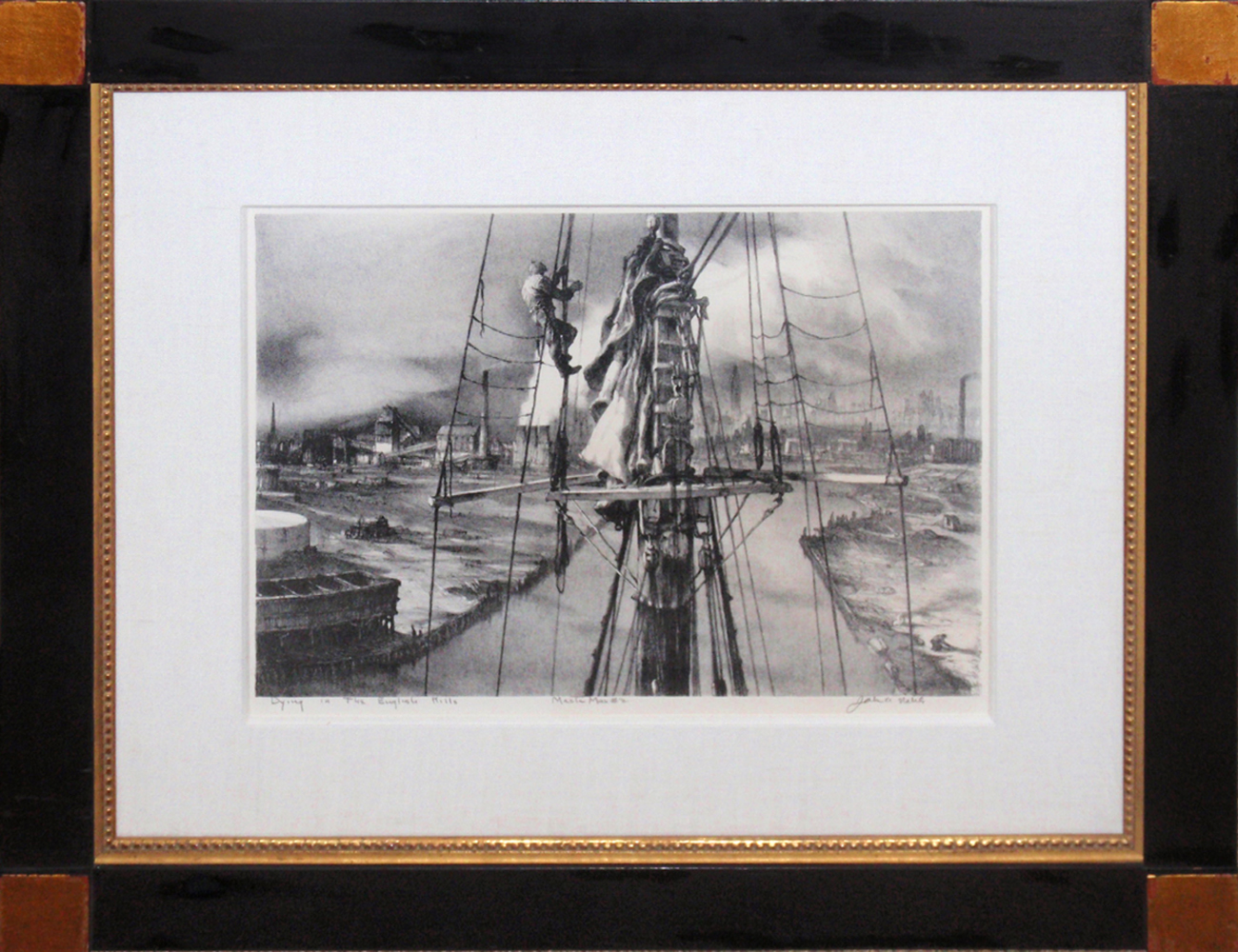
Dying in the English Kills, Man & Mast #2 (Brooklyn)
1967
Lithograph, edition of 300
Signed and titled in pencil
23" x 26 3/4" framed
  
Born in Paris in 1913, John A. Noble was the son of the noted American painter, John “Wichita Bill” Noble. He spent his early years in the studios of his father and his father’s contemporaries, innovative artists and writers of the early 20th century. A graduate of the Friends Seminary in New York City, Noble continued his studies in France at the University of Grenoble. There he met his wife and lifetime companion, Susan Ames. When he returned to New York, he attended the National Academy of Design.

Beginning at the age of 15 and continuing for almost two decades, Noble worked aboard schooners and in marine salvage. It was during this time that the artistic bug caught hold and Noble began drawing and painting. In 1928, while on a schooner that was towing out down the Kill van Kull- the tidal strait that separates Staten Island from New Jersey- he saw the old Port Johnston coal docks, “the largest graveyard of wooden sailing vessels in the world”, for the first time. He would later comment that this sight changed his life forever. In 1941, Noble began to build his floating studio out of parts from the vessels he salvaged. Noble would use a rowboat to explore the harbor, taking detailed records of the boats, workmen, and industries that came and went.

Despite his artistic provenance and critical praise of his work, Noble always remained intimate with the people of the coal docks. “I’m with factory people, industrial people, the immigrants, the sons of immigrants. It gives life to it,” he stated. Late in his life, Noble recalled his first compelling views of New York Harbor. “I was crossing the 134th Street Bridge on the Harlem River on a spring day in 1928, and I was so shocked--it changed my life. I was frozen on that bridge, because both east and west of the bridge were sailing vessels. And I thought sailing vessels, you know, were gone... There it was, and I couldn’t eat, or anything; I was so excited.” By the time of his death in the Spring of 1983 - shortly after the passing of his beloved Susan - the sailing vessels he loved were all gone, and the maritime industry in the area had diminished significantly.

Arader Galleries is proud to present John A. Noble’s Dying in the English Kills, Man & Mast #2 (Brooklyn). This exquisite lithograph portrays a mariner atop the mast on a sailing vessel navigating the English Kills, a tributary along the Newport Creek separating Brooklyn and Queens.

Edward Lear- artist, illustrator, author, poet


Edward Lear (12 May 1812 – 29 January 1888) was born in Halloway, England to a middle class family. As the second-to-last of twenty-one children, he was raised by his oldest sister, Ann, due to poor family finances. Lear also suffered from epilepsy and asthma from an early age - illnesses that would plague him his entire life. Lear became a paid artist at the age of 16 when he took a job with the Zoological Society as a “ornithological draughtsman.” He continued his work drawing the private menagerie of the Earl of Derby. His publication, Illustrations of the Family of Psittacidea, or Parrots, came about in 1830, when the artist was 18. His work was favorably received and compared to contemporary artists such as John James Audubon. At the age of 25, failing eyesight caused Lear to give up his detailed ornithological work. He moved to Rome in 1837 in an attempt to bolster his poor health.

For the next 50 years, Lear would travel all over the world exploring; supporting himself through his drawings, watercolors, and writings. His travels included forays in Greece, Palestine, Egypt, India and Ceylon (modern-day Sri Lanka). While traveling he produced numerous colored wash drawings that he would later build up with watercolor and oil. To share his experiences, Lear kept detailed journals documenting his day–to-day experiences and sketched the local topography. He later annotated his journals, letters, and sketches often purposely misspelling words and adding nonsensical phrases for publication.

Courtesy of 

The Project Gutenberg eBook, A Book of Nonsense, by Edward Lear

Lear passed away at his Italian villa in 1887 from heart disease. Sadly, none of his friends were able to attend the funeral.


Great Britain marked the centennial of his death with a set of Royal Stamps in 1988 and an exhibition at the Royal Academy. To mark the bicentennial of his birth, a range of events have been planned throughout the world on May 18 – International Owl and Pussycat Day – including a Google Doodle depicting the titular Owl and the Pussycat.

Arader Galleries is please to present a rare first edition of Lear’s Illustrations of the Family of Psittacidea, or Parrots. This publication marked the transition from engraving to lithography in natural history works. This work contains 42 lithographs with original hand-painted color. A run of only 175 books were produced, of which only 100 survive today. The quality of this work established Lear’s reputation as one of the best natural history artists of his time.

Edward Lear (1812-1888)
Illustrations of the Family of Psittacidae, or Parrots
London: Edward Lear, 1830-1832
Hardcover
Book Condition: Near Fine
Folio (21 x 14 inches)
Letterpress title-page, dedication leaf, list of subscribers, list of plates,
42 fine hand-colored lithographic plates by and after Lear.
Fine modern half diced calf marbled boards antique,
Please contact Arader Galleries for further details.