Showing posts with label North America. Show all posts

Wednesday, July 11, 2012

John A. Noble, American painter and mariner


"Anywhere men work or build on the water is of interest to me...My life's work is to make a rounded picture of American maritime endeavor of modern times."
John A. Noble (1913-1983)
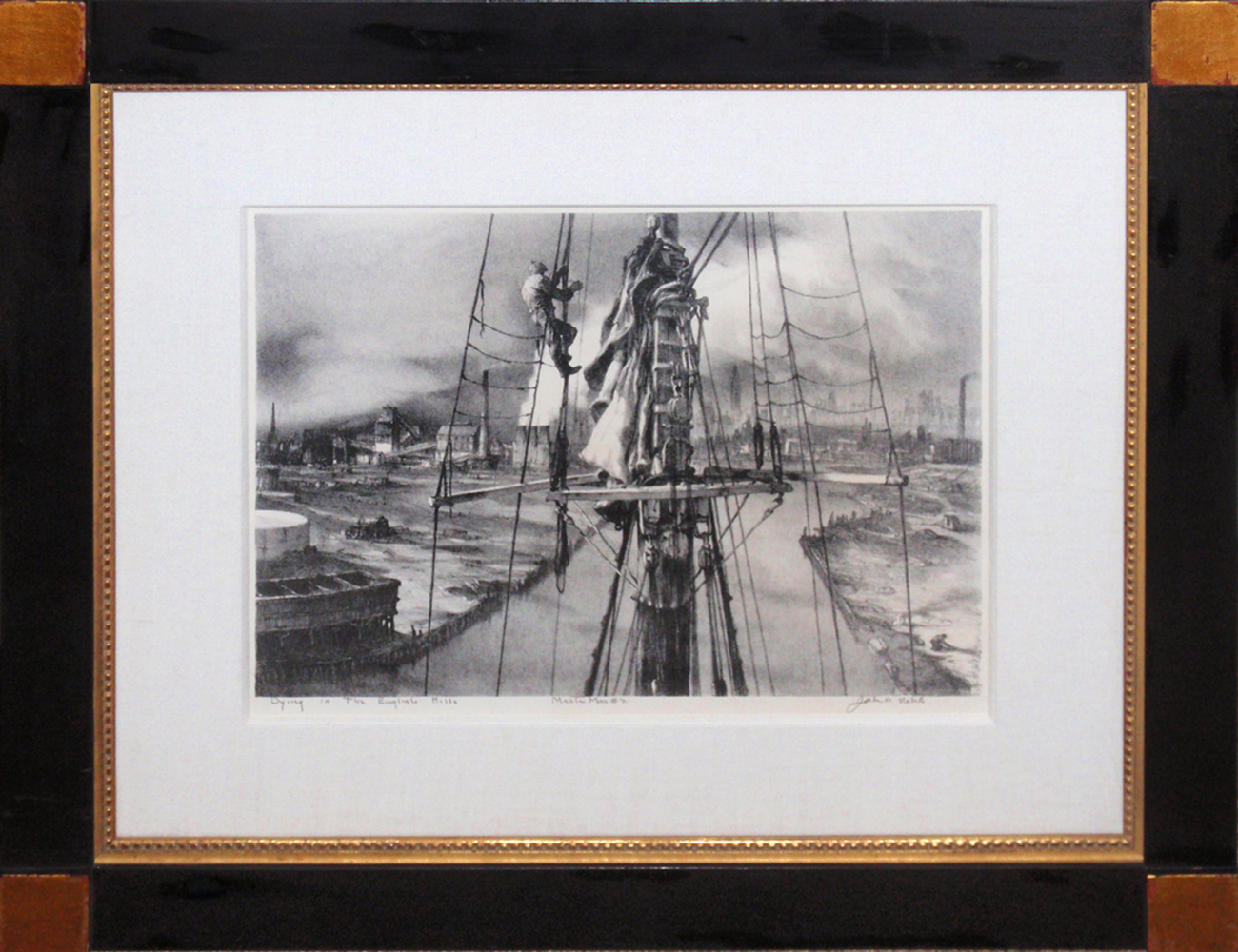
Dying in the English Kills, Man & Mast #2 (Brooklyn)
1967
Lithograph, edition of 300
Signed and titled in pencil
23" x 26 3/4" framed
  
Born in Paris in 1913, John A. Noble was the son of the noted American painter, John “Wichita Bill” Noble. He spent his early years in the studios of his father and his father’s contemporaries, innovative artists and writers of the early 20th century. A graduate of the Friends Seminary in New York City, Noble continued his studies in France at the University of Grenoble. There he met his wife and lifetime companion, Susan Ames. When he returned to New York, he attended the National Academy of Design.

Beginning at the age of 15 and continuing for almost two decades, Noble worked aboard schooners and in marine salvage. It was during this time that the artistic bug caught hold and Noble began drawing and painting. In 1928, while on a schooner that was towing out down the Kill van Kull- the tidal strait that separates Staten Island from New Jersey- he saw the old Port Johnston coal docks, “the largest graveyard of wooden sailing vessels in the world”, for the first time. He would later comment that this sight changed his life forever. In 1941, Noble began to build his floating studio out of parts from the vessels he salvaged. Noble would use a rowboat to explore the harbor, taking detailed records of the boats, workmen, and industries that came and went.

Despite his artistic provenance and critical praise of his work, Noble always remained intimate with the people of the coal docks. “I’m with factory people, industrial people, the immigrants, the sons of immigrants. It gives life to it,” he stated. Late in his life, Noble recalled his first compelling views of New York Harbor. “I was crossing the 134th Street Bridge on the Harlem River on a spring day in 1928, and I was so shocked--it changed my life. I was frozen on that bridge, because both east and west of the bridge were sailing vessels. And I thought sailing vessels, you know, were gone... There it was, and I couldn’t eat, or anything; I was so excited.” By the time of his death in the Spring of 1983 - shortly after the passing of his beloved Susan - the sailing vessels he loved were all gone, and the maritime industry in the area had diminished significantly.

Arader Galleries is proud to present John A. Noble’s Dying in the English Kills, Man & Mast #2 (Brooklyn). This exquisite lithograph portrays a mariner atop the mast on a sailing vessel navigating the English Kills, a tributary along the Newport Creek separating Brooklyn and Queens.

Thursday, July 24, 2008

One of the earliest publications on the flora and fauna of North America

Kingfisher by Catesby
Hermit Crab by Catesby

Arader Galleries is pleased to offer a selection of first edition, hand-colored copperplate engravings from Mark Catesby’s The Natural History of Carolina , Florida and the Bahama Islands . The first edition was printed between 1731 -1743 in London , and contains 220 plates published in two volumes, which depict birds, reptiles, fish, insects and mammals. The first volume was printed in 1731, and the second was printed in 1743. It is the first natural history book to use folio-sized color plates, and the first pictorial account of the f
lora and fauna of North America.

In 1712 the English born artist and naturalist embarked on a series of explorations to the southern colonies of British North America. Enthralled by the wildlife, he spent years traveling by foot through parts of present day Virginia, Georgia, the Carolinas and Bahamas. He encountered and documented uncountable varieties of animal and plant life that where entirely unknown to Europeans. These travels would become the basis for Catesby’s breathtaking book.

The Natural History of Carolina, Florida and the Bahama Island
is one of the most sweeping, complete and unique natural history study ever created. It is considered a crowning achievement of 18th century art and science. This work was completed at the same time Linnaeus was working on his Systema Naturae, and used Catesby’s work as the basis of his system of binomial nomenclature for American species.
When Catesby returned to England in 1726 he was unable to afford the expense of having his drawings engraved professionally so he taught himself. He also carefully monitored the coloring either painting the impressions himself, or closely supervising the colorist to insure its fidelity to the original studies.The book provided an important model for later artists including Audubon and Alexander Wilson, who followed in Catesby’s footsteps a century later. His pioneering attempts to describe and portray birds accurately, life-sized and in botanical settings set him apart from his contemporaries.

The first edition of Mark Catesby’s book was printed on imperial folio sized hand-laid papers (approximately 14-1/2 x 20-1/2 inches) with various plate mark dimensions (approximately 9-5/8 x 13-3/8 to at least 10-1/4 x 13-7/8 inches). Chain lines on the paper appear to be uniformly spaced at 1 inch. Two Watermarks identify the first edition of Catesby prints from later editions. The first is the “Strausburg Lilly” over the initials “LVG”, representing the Dutchman Lubertus van Gerre-vink. This is also the same paper in which many of his original drawings are mounted on. A second Watermark found in the first edition is the “IHS” over “I. VILLEDARY”, representing the Jesuits and the Jean Villedary.

Be sure to view our collection of Catesby and other natural history artists such as Audubon, Barraband and Gould at our San Francisco Jackson Square location at 435 Jackson St., or online at www.aradersf.com.

Thursday, May 29, 2008

California as an Island maps


One of the most interesting cartographic myths of the European exploration of the Americas was maps depicting California shown as an island. This famous misconception impacted the accuracy of mapmaking for over a hundred years, until its acceptance of California as part of the mainland was established in the mid-eighteenth century.

Between the years of 1500 and 1747, a lot of confusion ensued over whether or not California, a mysterious land with an abundance of gold, was in fact an island. As early as 1500, California was thought to be an island. As more and more explorers ventured up the coastal region, it was established that California was, in reality, part of the mainland. This discovery, however, did not last long as miscommunications and mistaken observations turned the coast back into an island!

Beginning in the year 1622, California began its cartographic existence as a large island off the coast of Newe Spaine, accompanied by an article by Henry Briggs. The “island of California” appeared to have a rough and rocky coastline complete with smaller islands off the shore. The theory became universally accepted over the next ten years as influential published such as Nicolas Sanson, Fredrick de Wit and Nicolas de Fer created beautiful maps that confirmed California’s insularity. Some maps even highlighted a functional Northern coast with finger-like peninsulas reaching towards the mainland.

Father Eusebio Kino confirmed that California was part of the landmass of America in 1698 by walking to California from the mainland without encountering a body of water, then showing his results in a map published in 1705. Still, it was not until 1747 when Ferdinand VII of Spain declared it part of the mailand, by royal decree stating, “California is not an Island,” that cartographers began to eliminate the myth. Interestingly, the practice of depicting California as an island lasted until 1865 in Japanese cartography.

Arader Galleries is pleased to present to you our collection of these cartographical curiosities, all of which are currently available for purchase at our San Francisco location. Please contact us with any questions you have about this fascinating collection.