Sunday, April 3, 2016

The Oakes Ames Orchid Watercolor Collection Exhibited at Filoli April 5th-June 12th

Charles Storer
Cypripedium Curtisii, 1898
Original Watercolor
13 7/8" x 9 7/8"
We are excited to announce our presence at Filoli's Annual Botanial Art Exhibition from April 5th-June 12th showcasing the gallery's fine original watercolor works from Oakes Ames' Orchid Collection.

Artist Reception

Thursday, April 7, 5:00 pm – 7:00 pm
For ticket and reservations: Click Here

Filoli is a "654–acre property, including the 36,000 square foot Georgian country house and spectacular 16–acre English Renaissance garden. Admission to Filoli allows visitors to explore the historic House and Garden at their leisure. The Filoli Botanical Art Exhibit has long been an essential part of our Botanical Art Program’s mission to interpret and preserve this historically significant art form. With its exquisite formal Garden, heirloom orchard and nature preserve, Filoli is a unique and fitting venue for this historical art form that has rendered plants throughout history and from around the world.  In the historic House a collection of botanical illustrations will be on display in the elegant Ballroom and select pieces will be displayed in the Trophy Room."

Orchids and Oakes Ames
Blanche Ames
Cypripedium Kimballianum, 1900
Original Watercolor
14" x 10"
The incredible Oakes Ames collection of watercolor orchids was gifted to the Massachusetts Horticultural Society by famed botanist Oakes Ames (1874 - 1950). Through his life’s work on the orchid family, he and his wife Blanche unveiled the mysteries of this strangely beautiful plant species to the rest of the world. These gorgeous and delicate watercolors were part of Ames’ personal collection of orchid paintings, featuring works by the botanist himself, his wife Blanche, Charles Storer, J.L. Macfarlane, Putzys, and several by unidentified artists.  As part of his exhaustive research on orchids, Ames made expeditions to Florida, the Caribbean, the Philippines, and Central and South America with his wife, creating scientific drawings and watercolors of each plant they cataloged. The Ames' work was published in the seven-volume Orchidicae: Illustrations and Studies of the Family Orchidicae. 

To purchase Ames' watercolors you see at Filoli  please call 415-788-5115. 
Arader Galleries, at 435 Jackson Street, San Francisco. 


Sunday, March 27, 2016

From Sea to Shining Sea: Karl Bodmer's American Expedition

Embouchure de Fox-River
23 ¼ x 17 ½
Karl Bodmer's is known for his magnificent series of ethnographic accounts of Plains Indian culture during the time of 19th century western expansion. Bodmer was an unassuming Swiss painter when he was chosen by Prince Maximilian of Prussia to accompany his voyage to America, in order to document in pictorial terms his expedition. With the rest of Maximilian’s company, the two traveled among the Plains Indians from 1832 to 1834, a time when the Plains and the Rockies were still virtually unknown. The Bodmer/Maximilian collaboration produced a record of their expedition that is incontestably the finest early graphic study of the Plains tribes. Together the documented writing of Maximilian’s travels coupled with the iconic scenes of the West produced the seminal publication Travels in the Interior of North America, 1832-1843


Though Bodmer is most noted for his ethnographic drawing and paintings of the Plains Indians but his scenes of the North American views captured the mystique and majesty of the vast and diverse American  landscape. Maximilian and Bodmer journeyed from St. Louis up the Missouri River on the American Fur Company steamboat “Yellowstone,” stopping at a series of forts built by the Fur Company and meeting their first Indians at Bellevue. The travelers continued  to Fort Union, Fort Clark, and Fort Mackenzie, which proved to be the western most point of their journey. After living among and studying the Blackfeet tribe for several weeks, Maximilian decided that it was too dangerous to continue, so the travelers returned southward, reaching St. Louis in May 1834.

 Forest Scene of the Lehigh
23 ½" x 17 ½"

Cleveland Lighthouse
17 ½" x 12"
Once the journey was over, Bodmer spent four years in Paris supervising the production of the aquatints made from his drawings.These spectacular and atmospheric images are important and beautiful records of the landscape of the American West as it appeared when Bodmer saw it, just before westward expansion and industrialization took hold and began the indelible transformation of the frontier.

Junction of the Yellowstone River with the Missouri
24" x18"
A Selection of Bodmer's North American Views and Ethnographic works are available for purchase at Arader Galleries 432 Jackson St. San Francisco, CA 94111 
Please call 415-788-5115 with any questions

Sunday, March 20, 2016

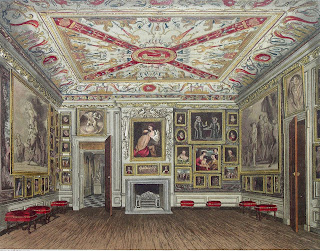
W.H. Pyne's History of Royal Residencies: 100 Fantasticly Designed Palace Interiors

William Henry Pyne (1769-1843)
Ante Chamber, Carlton House
From: The History of Royal Residences, 1819
Hand-colored aquatint engraving
11"x13"
In the early nineteenth century English interior decorative taste was heavily influenced by revival architecture and design motifs from previous centuries past. This trend of appropriating old world motifs and crafting pastiche furnishings borrowed from ancient Greece and renaissance Italy. Neoclassicism better known as England's Regency Era (1783-1837) was influenced by King George IV. Order and symmetry were two key factors in Regency aesthetic achievement, as showcased in W.H Pyne's publication The History of Royal Residencies, 1819.

William Henry Pyne (1769-1843) was a British painter, illustrator, cartoonist and writer. He was the son of textile workers, a leather seller and a weaver, but Pyne had aspirations of pursuing classic artistic endeavors. Pyne trained at the academy of Henry Pars in London and first exhibited at the Royal Academy in 1790.

Pyne's grand undertaking, The History of Royal Residences of Windsor Castle, St. James Palace, Carleton House, Kensington Palace, Hampton Court, Buckingham House and Frogmore...featured 100 commissioned hand painted aquatints of Royal interior and exterior architectural and interior design. These spectacular interior and architectural views displayed the detailed and extravagant decor of Royal peoples from iconic English palaces and landmarks.                           

W. H. Pyne
Presence Chamber, Kensington Palace
From: The History of Royal Residences, 1819
Hand-colored aquatint engraving
11"x13"
Though the publication slowly gained popularity and interest, the cost of self publishing such a extensive and artistically sophisticated book placed Pyne in financial ruin for the latter part of his life.

However, Pyne's work continues to be historically significant for documenting architectural history; such as Windsor Castle before architect Jeffrey Wyatville’s extensive alterations were made in 1824. As well as featuring St. James’s Palace,  and Carlton House; interiors created for the Prince Regent by Holland with Wyatt and Nash as architects. The History of Royal Residencies... also showcases Kensington Palace, Hampton Court, Buckingham House and Frogmore as remodeled by architect James Wyatt.
W. H. Pyne
Queen’s Audience Chamber, Windsor Castle
From: The History of Royal Residences, 1819
Hand-colored aquatint engraving
11"x13"

W. H. Pyne
King’s Writing Closet, Hampton Court
From: The History of Royal Residences, 1819
Hand-colored aquatint engraving
11"x13"

Pieces from this extravagant series of detailed Royal English households are available for purchase at Arader Galleries, 432 Jackson Street, San Francisco. Please call 415-788-5115 with any questions.

Wednesday, August 26, 2015

Recreating Paintings in 'The Temple of Flora'

Robert John Thornton (circa 1768-1837)
The Queen
1804
 Aquatint, mezzotint and stipple engravings finished by hand
Painter- Peter Henderson
Thornton’s Temple of Flora combines the scientific with the artistic. The images portray the worlds most exotic flowers and plants at the time placed into vast mountainous landscapes creating an overall spectacular sight for viewers. Thornton worked with various painters to create the images in paint, then with the help of engraver James Caldwell to recreate them in print using Intaglio printing methods.

Intaglio, coming from the Italian word intaglione, is an ancient printmaking process dating back to 400 B.C. in which ink is applied to a copper or zinc plate, wiped off the surface than printed under high pressure. Ink that remains in the grooves of the plate is transferred onto the paper from the pressure of the press. These grooves can be physically scratched into the plate via dry point engraving or etched using feric acid. 

Mezzotint, in addition to engraving and aquatint methods, were used to achieve gradation without the use of line or crosshatching. This is a method where the engraver uses a tool called a ‘Roulette’ to make small repeating dots or lines, creating the illusion of shadow and/or light. Small rotating teeth create grooves in the plate for ink to hold which then transfers to paper when run through a high pressure printing press. All of the prints in Thornton's ‘Temple of Flora’ were hand water-colored after printed to get a full range of color. The prints displayed are from Thornton's Temple of Flora, each one painted by a different artist then re rendered on copper using various methods to replicate the depth and color range of the original. 

Aquatint refers to the process of etching the copper plate with acid instead of physically removing material. The ‘etcher’ prepares the plate with a dusting of fine resin, and then heats the plate to fix the small particles. These small particles act as a stop out to the acid which creates tonal regions on the plate. Areas that touch acid will be etched and will have a tone. The longer the plate is in the acid for, the darker the tone. States or stages of aquatint can be added to create multiple shades of color or tones.

Robert John Thornton  (circa 1768-1837)
The Blue Passion Flower
1800
Aquatint, mezzotint and stipple engravings finished by hand
Painter- Philip Reinagle
Robert John Thornton (circa 1768-1837)
The Persian Cyclamen
1804
 Aquatint, mezzotint and stipple engravings finished by hand
Painter- Abraham Pether (1731-1795)


Tuesday, August 25, 2015

Charming 18th Century Painting of Birds


Christopher Huet (French, 1694-1759)
"Ruffs in a Landscape"
Oil on canvas
Canvas size: 20 1/2” x 17 3/8”
Literature: Christine E. Jackson, Bird Painting - The Eighteenth Century (Woodbridge, Suffolk, 1994), p. 76
Christopher Huet’s informal and intimate painting places male and female specimens of the species Philomachus pugnax in their natural habitat of marshy wetlands. The bird was first introduced to the English in 1586 when an anonymous writer published an attack upon the large frilly lace ruffs currently the fashion among Elizabethan men and woman. He scornfully likened these extravagant collars to the ruff worn around the neck of the male ruff bird when in breeding plummage.

Huet’s charming painting was most probably designed to appeal to members of the French aristocracy among whom he found continued employment. He specialized in the depiction of natural history subjects as well the interior decoration of houses. His skills were such that his name can be found along side that of Watteau in the account books of the Prince de Conde documenting work completed at the family castle in 1741.


This elegant painting is now on display at Arader Galleries, at 435 Jackson Street, San Francisco. Please call 415-788-5115 with any questions.

Thursday, April 16, 2015

Upcoming Auction & Christopher Columbus Atlas

Watch Graham Arader discuss atlases that dramatically changed our world view during the Age of Discovery on Bloomberg T.V.

These atlases among other historically important works will be coming up for auction this Saturday at 1PM Eastern Time. To download a catalog, please visit our website, aradersf.com or register online at www.liveauctioneers.com

Thursday, March 26, 2015

Art in the Age of European & American Exploration Auction, April 18, 2015

Arader Galleries in conjunction with Mid-Hudson Auction Galleries will be hosting an Auction of Art in the Age of European & American Exploration on April 18, 2015 at 1 pm at 1016 Madison Avenue, New York City. 


The auction is filled with John James Audubon's masterpieces from two very different works - the first, of course, The Birds of America, has quite a few masterpieces for sale: the Snowy Owl (Lot 14) being the finest.  Audubon’s “Snowy Owl” is one of the most desirable images from his monumental Birds of America: one of his very few nocturnal scenes, and certainly one of the most vibrant and charming full-page illustrations of his 435-plate series.  Other highlights include the beautiful Scarlet Ibis (Lot 10), the Bird of Washington (Lot 18), and finally the Canvas Backed Duck (Lot 7), President Reagan’s favorite, he loved the images with cities in the background.  
 
The next part of the sale is a continuation of Audubon's "other" work the Viviparous Quadrupeds of North America published as lithographs in Philadelphia by J.T. Bowen between 1845 and 1848. This collection of 70 quadrupeds have the finest color, best pull, and right patina of paper and ink, with full margins, and no restoration or repairs. It is a wonderful collection of nature's smaller and more interesting creatures, which can be bought at very affordable prices. The highlights include the Swift Fox, Canada Porcupine, Armadillo, and Tawny Weasel (Lots 21-91).

The sale continues with a lengthy section of framed maps from renowned cartographers such as Ortelius, Mercator, Blaeu, and Jaillot, among many others. There are early examples of world maps, rare manuscript maps, views of American cities such as, New York and Minneapolis, as well as Celestial Charts showing the Zodiac including the most decorative 17th century chart of the heavens, and an exemplary collection of beautiful atlases from the 16th - 18th Centuries.
 
Additionally, there is a selection of Currier & Ives prints and other Historic and Genre Scenes on paper. Following is a wonderful selection of Natural History Flora and Fauna including engravings from Dr. Robert Thornton’s Temple of Flora; or Garden of Nature (Lots 194-201) watercolors for Pierre-Joseph Redouté’s Les Liliacées (Lots 202-211), and ), both watercolors and engravings by Jacques Barraband for his Histoire des Perroquets (Lots 212-221).Last is a section of paintings and watercolors including those by Thomas Birch, Charles Wimar, and Edward Moran, in addition to a superb sixteenth-century portrait of famed geographer Abraham Ortelius by Adrien Key, which was the only portrait painted of Ortelius during his lifetime (Lot 235).

Please contact Arader Galleries if you would like to be sent a catalog or if you would like to bid online. We would be happy to assist you.

415-788-5115